TV setup accessory compatibility and fit
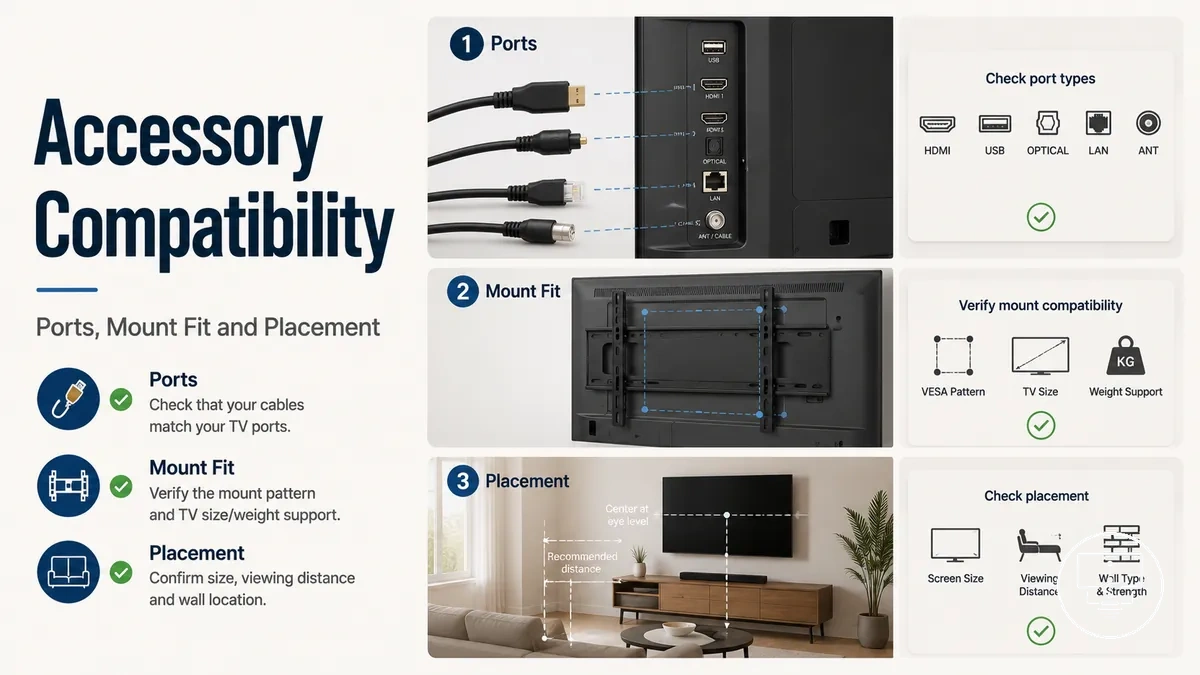
TV setup accessory compatibility and fit refers to how TV setup accessories match a TV based on compatibility conditions such as TV specifications, physical fit, supported standards, and usage requirements. This includes alignment with ports, VESA patterns, HDMI connections, mounting structure, accessory requirements, and room layout constraints. Compatibility depends on both the TV and the accessory working together within these defined limits rather than following a single universal rule.
In many cases, users face uncertainty before purchasing because different TVs vary in specifications, port configurations, and mounting options. A setup that works in one environment may not work in another if the TV specifications differ or if physical fit and room layout constraints are not considered. This makes it necessary to evaluate compatibility through multiple factors such as ports, mounting support, connection standards, and the overall placement conditions in the room.
TV setup accessories are ready for practical use only when compatibility aligns with the required TV specifications and installation conditions. This means checking whether ports support the needed connections, whether VESA mounting patterns align with brackets, and whether the physical setup matches space and clearance needs. These conditions guide whether an accessory can function as intended within a specific setup environment.
Product examples may be used later, but they remain secondary to the compatibility framework. The primary focus stays on how TV specifications, mounting requirements, connection standards, and room layout collectively determine accessory fit.
What compatibility means for TV setup accessories
TV setup accessories compatibility is the fit between TV setup accessories and a TV based on physical, electrical, connection, software, and room-placement requirements. It defines whether accessory fit aligns with the TV model requirements and supported standards, making compatibility a conditional outcome rather than a fixed property. This means the result depends on how the accessory and TV model interact across multiple constraints such as port type, VESA size, weight limit, supported standard, and control support.
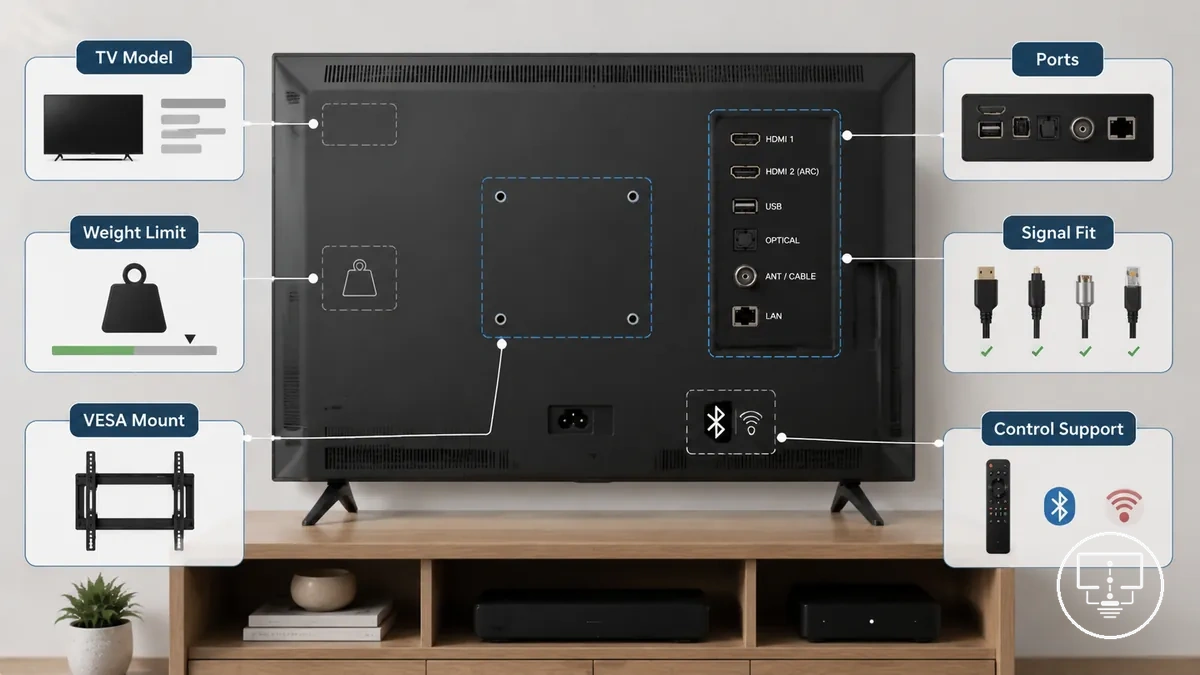
Many users assume TV setup accessories are universally compatible, but this is not accurate because accessory fit changes with each TV model and its requirements. Physical compatibility (such as VESA size and weight limit) and functional compatibility (such as port type, supported standard, and control support) must both align for proper use. A simplified universal description can reduce uncertainty, but it does not replace model-specific checking of compatibility conditions.
Compatibility can be understood through a clear separation of core dimensions that determine whether a setup matches a TV model:
- Physical fit based on VESA size, mounting structure, and weight limit
- Electrical fit based on power requirements and supported standards
- Connection fit based on port type and signal support
- Control support based on TV model software or remote compatibility
- Room-placement fit based on layout and installation constraints
TV specifications that control accessory fit
TV specifications control how TV setup accessories fit, connect, and function because accessory compatibility depends on verified TV-level requirements rather than assumptions. These TV specifications include model identifiers, ports, signal standards, VESA pattern, screen size, weight, clearance, and smart features. Compatibility cannot be determined from a single value, so these specifications must be checked together to understand overall accessory fit and risk.
In practice, users review the TV spec sheet or manual to match specification groups against accessory requirements before installation. The image below highlights where these TV specifications appear on a TV and how they relate to accessory fit conditions.
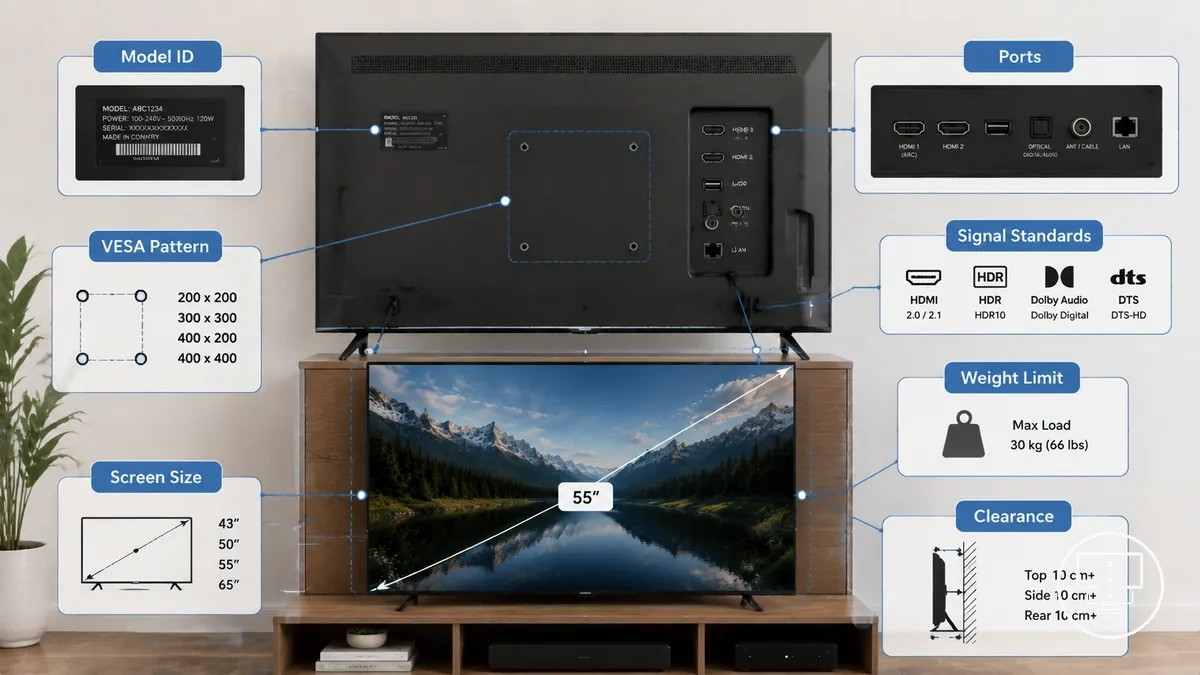
The table organizes TV specifications by what each one controls in accessory compatibility, separating physical, connection, and functional requirements.
| TV specification | Accessory requirement controlled | Value or condition to check | Compatibility effect |
|---|---|---|---|
| Model identifiers | Specification match | Exact model reference in manual or label | Defines base compatibility scope |
| Ports | Connection support | HDMI, USB, input availability | Determines device connectivity |
| Signal standards | Media compatibility | Supported audio/video formats | Affects playback or signal output |
| VESA pattern | Mount alignment | Hole pattern configuration | Determines mount fit |
| Screen size | Physical scaling | Display size class | Affects mounting and spacing fit |
| Weight | Load requirement | TV weight specification | Influences mount safety limit |
| Clearance | Installation space | Rear space and wall distance | Affects cable and mounting placement |
| Smart features | Control support | OS and remote compatibility | Determines functional integration |
These specification groups show that TV setup accessories compatibility depends on multiple aligned conditions rather than a single match point. Physical fit such as VESA pattern or weight must align with connection factors like ports and signal standards, while smart features affect control behavior. Separating these checks helps distinguish pre-purchase validation from setup-stage adjustments where placement and clearance become more relevant.
Model number, manual details, and product specifications
Model number, manual details, and product specifications define whether a TV setup accessory can fit, connect, or operate safely because they anchor the verification to the exact TV model. The model number identifies the exact device variant, the manual provides structured installation and compatibility rules, and product specifications define measurable requirements such as ports, mounting details, and power conditions. These written specifications reduce guesswork by replacing assumptions with verified reference data for the TV model.
In practice, model number, manual, and product specifications are checked to confirm accessory requirements before installation. This reduces uncertainty when matching ports, VESA pattern, or power constraints by relying on documented specification values tied to the exact TV model as the controlling reference.
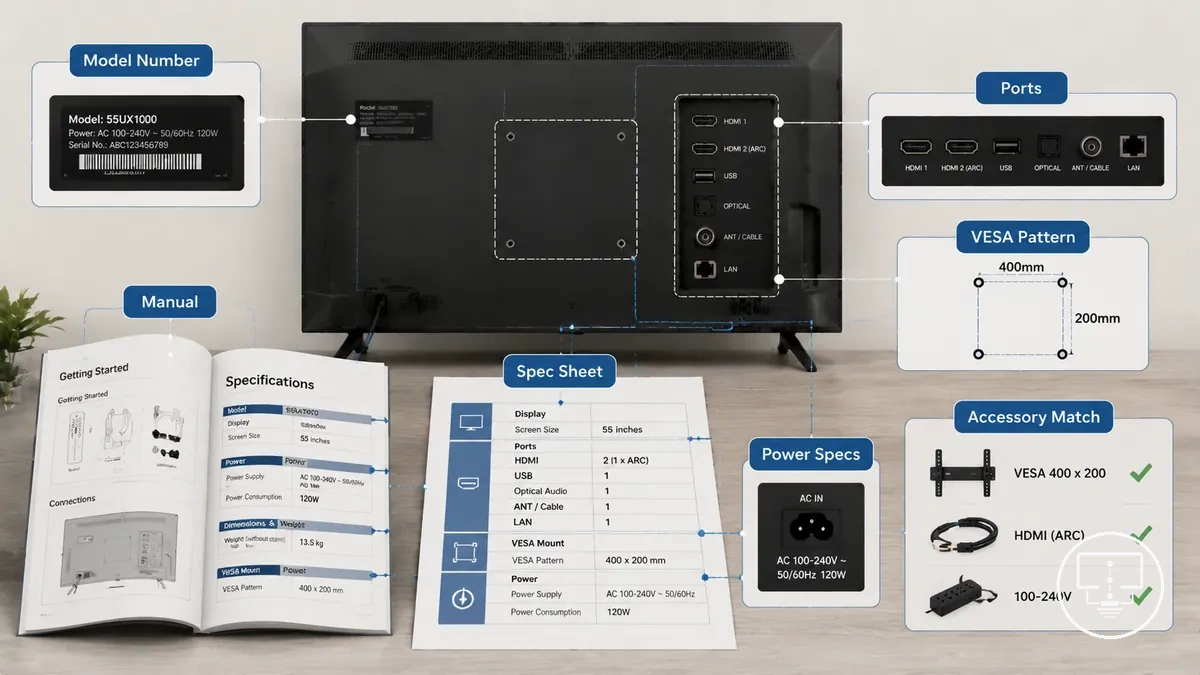
The mini-checklist below shows how model-level verification is used to confirm compatibility decisions before setup and installation.
- Exact model number match on the TV label or spec sheet
- Manual entry confirming installation and accessory guidance
- Port specification alignment with accessory requirement
- VESA or screw detail for mounting compatibility
- Power or control requirement listed in product specifications
- Accessory requirement match against documented TV model data
Regional variants or reused model names may appear similar across markets, but written product specifications and the exact model number should always override appearance. In such cases, the manual and specification value remain the controlling reference for determining accessory limitation or support.
Ports, signal support, and TV feature labels
Ports, signal support, and TV feature labels determine whether connected accessories perform as expected because they define both physical connection points and functional capability. A connector may fit into a port, but signal support can still differ based on the TV feature labels and configuration. This separation is critical because connector shape alone does not confirm full performance compatibility.
These ports and labels include HDMI, ARC or eARC, optical, USB, coaxial, antenna, Ethernet, resolution, refresh rate, power output, and TV feature labels. Each element represents a different layer of support, from audio and video transmission to network access and device power behavior. To understand compatibility clearly, it helps to compare how each port or label affects performance conditions.
| Port or label | What it may support | Condition to verify | Compatibility effect |
|---|---|---|---|
| HDMI | Audio and video signal | Supported HDMI version and device output | Affects display quality and media transmission |
| ARC / eARC | Audio return channel | TV feature label support for ARC or eARC | Controls external audio system behavior |
| Optical | Digital audio output | Audio format compatibility | Enables sound system connection |
| USB | Media playback or power output | Power output level and format support | Determines accessory and media support |
| Coaxial / Antenna | Broadcast signal input | Regional broadcast standard support | Affects TV signal reception |
| Ethernet | Network connection | Network and TV system support | Enables wired internet features |
| Resolution | Display output quality | Device and TV resolution match | Influences image clarity |
| Refresh rate | Motion performance | Supported output rate from source device | Affects motion smoothness |
| Power output | Accessory powering | USB or port power capability | Defines accessory power availability |
| TV feature labels | Functional support markers | Verified feature listing in TV specifications | Determines enabled or limited functions |
In practice, a physical connection such as HDMI or USB may still show limited functionality if the TV feature labels do not support the required signal behavior. This contrast between connector shape and signal support explains why compatibility depends on both physical and functional verification rather than plug fit alone.
Screen size, weight, rear layout, and clearance
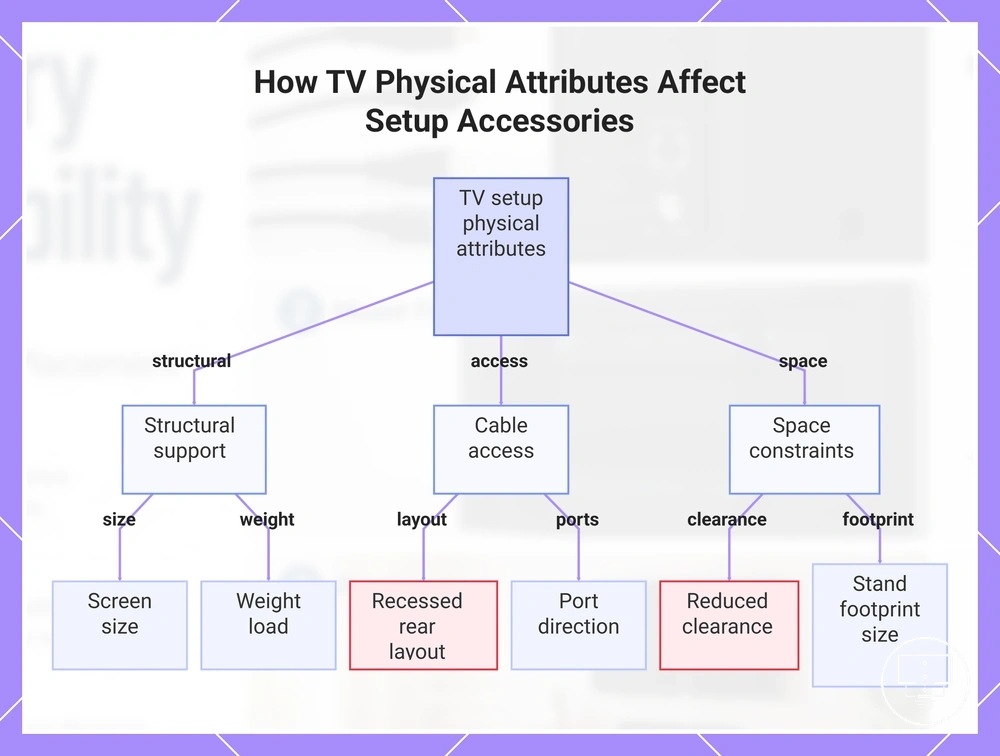
Screen size, weight, rear layout, and clearance define how TV setup accessories physically interact with the display because they control support load, spatial access, and positioning constraints. Screen size and weight influence structural support needs, while rear layout and clearance affect how easily accessories can attach, route cables, or align with available space. This makes physical fit dependent on multiple measurements rather than a single fixed condition.
These physical attributes shape how accessories perform in real placement conditions. Screen size and weight affect bracket fit and overall stability, while rear layout and port direction influence cable access and adapter reach. Clearance, stand footprint, and cable exit direction determine how much usable space is available for connection and adjustment, especially in constrained setups.
- Screen size affects overall positioning and proportional space usage
- Weight influences support requirements and load handling
- Rear layout changes access to ports and connection points
- Clearance determines available space behind the TV
- Stand footprint impacts placement stability on surfaces
- Cable access is shaped by port direction and exit space
In slim TVs or tight wall setups, reduced clearance and recessed rear layouts can limit cable access and make adjustments more restricted. In such cases, bracket fit and placement outcome depend heavily on how all physical measurements interact rather than any single attribute alone.
This chart shows how screen size, weight, rear layout, and clearance interact to determine support, cable access, and placement constraints for TV mounting accessories.
Cable and adapter compatibility
Cable compatibility and adapter compatibility depend on both connector fit and the signal support or power requirement behind the connection. A physical match between plug and port is not enough on its own, because signal support and power delivery define whether the connection performs as expected. This separation makes connector fit only one layer of compatibility.
Before comparing cable and adapter types, it helps to group them by port requirements, supported features, and typical limitations. The table below organizes HDMI, antenna, coaxial, optical audio, USB, right-angle adapters, splitters, and converters using these criteria to clarify how each behaves in real setups.
| Cable or adapter type | Port or feature required | Value or condition to check | Compatibility effect |
|---|---|---|---|
| HDMI | HDMI port | Supported HDMI version and device output | Defines audio and video signal performance |
| Antenna | Antenna input | Broadcast standard support | Enables live TV signal reception |
| Coaxial | Coaxial port | Signal format compatibility | Supports RF signal transmission |
| Optical audio | Optical port | Audio format support | Provides digital audio output |
| USB | USB port | Power output and data support | Enables media playback or accessory power |
| Right-angle adapter | Matching port type | Space and orientation requirement | Changes direction without changing signal capability |
| Splitter | Source port | Signal sharing support | Divides one signal across outputs with possible limitation |
| Converter | Different port types | Format conversion support | Changes connection format but not underlying capability |
Adapters and cables can adjust direction, format, or connection type, but they do not upgrade the TV’s underlying signal capability. For example, a converter may allow a connection between different ports, yet resolution, audio behavior, and power limits still depend on the original device and TV support. These cases show that adapter compatibility remains conditional on both connector fit and signal or power constraints.
cable compatibility provides the broader context for how connector, signal, and power factors interact across different TV setup accessories.
HDMI version, resolution, refresh rate, and backward compatibility
HDMI version, resolution, refresh rate, and backward compatibility determine how a TV setup handles video and audio performance through an HDMI cable. The connection depends on both the HDMI cable capability and the connected device capability, so both must align for stable output. This makes performance dependent on the full signal chain, not only the cable label.
HDMI performance varies based on HDMI version, bandwidth, resolution support, refresh rate handling, and features such as ARC or eARC. Higher HDMI standards can support higher resolution and refresh rate, but only when the TV and connected device also support those features. Backward compatibility often allows older HDMI devices to connect, but performance is limited by the lowest supported standard in the chain.
Before comparing capabilities, it helps to separate cable capability from device capability:
| Cable or label | TV / device requirement | Possible limitation |
|---|---|---|
| HDMI cable (high version) | TV and connected device must support matching HDMI version | Cannot enable unsupported resolution or refresh rate alone |
| 4K / 8K signal support | Both TV and connected device must support target resolution | May downgrade if one device is lower standard |
| High refresh rate support | Source device and TV refresh capability must align | Performance limited by weakest refresh support |
| ARC / eARC audio | TV port and audio system must support ARC or eARC feature | Audio features depend on TV feature support |
Older HDMI ports may still support basic video output, but advanced features like higher refresh rate or enhanced audio return depend on both device and TV capability. Backward compatibility allows connection between different HDMI versions, but output performance is always constrained by the lowest supported standard in the chain.
Coaxial, antenna, optical, USB, and adapter fit
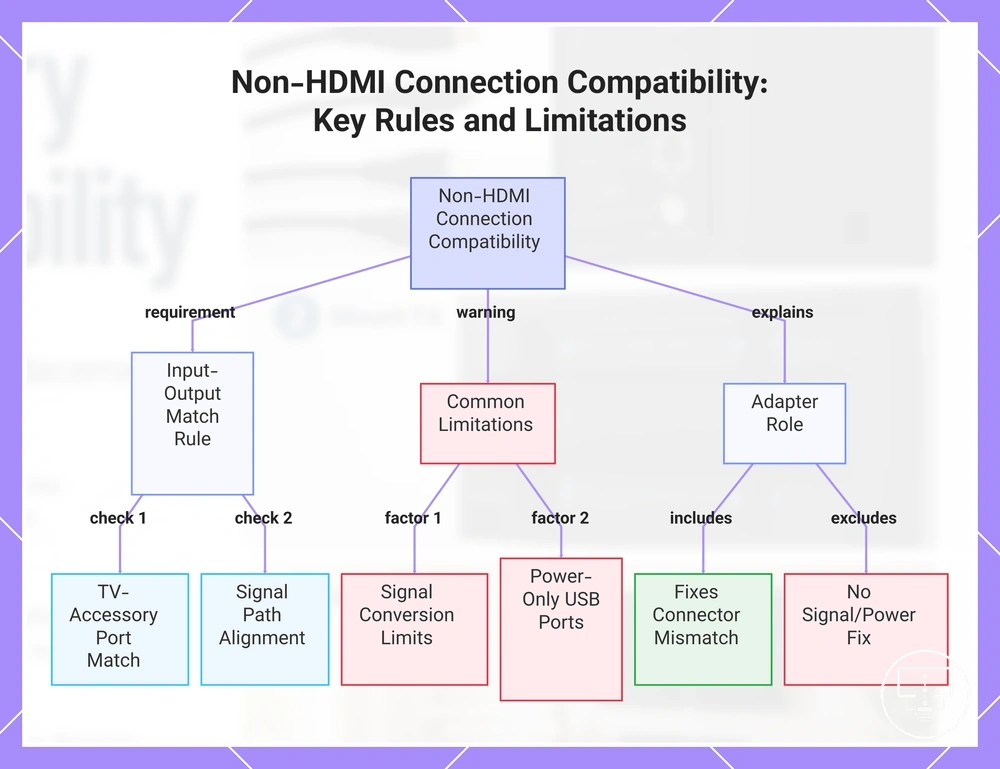
Coaxial, antenna, optical audio, USB, Ethernet, and adapter fit depend on matching both the TV input and the accessory output. A correct connection requires alignment between the port family and the signal path, not just physical shape. This means compatibility depends on input match first, then how the output behaves across signal or power conditions.
These non-HDMI connections operate under different signal and power rules, so compatibility must be checked by port family and function together. Coaxial and antenna rely on broadcast input matching, optical audio focuses on digital sound output, USB and Ethernet depend on data or network support, and adapters may change direction or format but not the underlying capability. In many cases, limitations appear when signal conversion or power-only USB ports are involved.
- Coaxial: Requires matching RF input and compatible broadcast output; limited to supported signal formats
- Antenna: Requires correct tuner input and regional broadcast output; cannot convert unsupported standards
- Optical audio: Requires optical input/output alignment; limited to supported digital audio formats
- USB: Requires data or power output match; power-only ports may not support media or accessory data
- Ethernet: Requires network input/output compatibility; performance depends on TV network support
Adapters can solve connector mismatch by changing physical direction or shape, but they may not resolve signal conversion, power delivery, or feature support differences. This distinction is important because adapter compatibility depends on both the connector and the underlying signal path behavior between devices.
This chart shows the key compatibility rules, common limitations, and adapter role for non-HDMI connections such as coaxial, antenna, optical, USB, and Ethernet.
Mounting and placement compatibility
Mounting and placement compatibility depends on whether the TV’s physical measurements align with the mount structure and room constraints. It is determined by VESA pattern, screw size, load rating, TV size range, bracket clearance, stand width, and cable access. These factors influence mounting fit and placement compatibility, and mismatches can affect stability and usable positioning depending on the setup conditions.
To evaluate mounting fit in a structured way, key conditions can be grouped into a compact checklist that separates structural, spatial, and access-related risks. This helps clarify how each measurement affects compatibility before comparing mounting or placement options.
| Mounting or placement condition | Measurement to check | Risk if mismatched | Decision signal |
|---|---|---|---|
| VESA pattern | Hole spacing standard | Mount does not align | Exact alignment required |
| Screw size | Thread type and length | Loose or unstable fit | Exact match required |
| Load rating | Weight support capacity | Overload risk | Must exceed TV weight |
| TV size range | Supported display size | Physical incompatibility | Within supported range |
| Bracket clearance | Rear spacing depth | Wall or movement restriction | Adequate clearance needed |
| Stand width | Base span measurement | Instability on surface | Stable surface coverage |
TV-side criteria define whether the display can physically attach and remain supported under load. VESA pattern and screw size determine direct mounting alignment, while load rating and TV size range influence structural compatibility. Bracket clearance also affects how the TV sits against the wall or mount frame.
Room and access conditions influence practical placement after structural fit is confirmed. Stand width and wall context affect stability, while viewing position and cable access influence usability and setup flexibility. These conditions often determine final placement outcomes even when mounting compatibility is technically met.
Further detail on physical attachment behavior is covered under mounting fit, where placement constraints and structural alignment are evaluated in more depth.
VESA pattern, screw size, and mounting hole spacing
VESA pattern, screw size, and mounting hole spacing determine whether a bracket or spacer kit attaches correctly to the TV back panel. These measurements define the physical alignment between the TV and the mounting interface, and they directly control bracket fit. When any of these values do not match, attachment usually depends on model-specific adjustments rather than a standard configuration.
The measurements verify bracket fit and spacer requirements by comparing the TV back panel layout with the mount’s hole structure. VESA pattern defines the width and height spacing, screw size defines the required diameter and thread compatibility, and mounting hole spacing confirms alignment accuracy. Screw length and spacer kit use may also influence final bracket fit when the back panel is recessed or uneven.
Curved TV backs, recessed mounting holes, or missing manufacturer screws can affect how these measurements apply in practice. In these cases, screw size and spacer requirement often depend on the TV model design rather than a fixed rule, which makes bracket fit more conditional across different setups.
Mount load rating, TV size range, and bracket clearance
Mount load rating, TV size range, and bracket clearance determine whether a TV setup accessory can support the display safely under real usage conditions. These factors define the relationship between TV weight, mount limit, and available space around the bracket. Safety depends on matching these constraints, and it may vary depending on the specific configuration and installation context.
To evaluate safe compatibility, load and clearance conditions should be checked together because they directly influence stability and movement behavior. The following safety checklist helps verify the key conditions that affect safe use.
Safety checklist:
- TV weight alignment with the mount load rating
- Mount limit compared with expected load demand
- TV size range compatibility with bracket design
- Bracket movement type and related stress during adjustment
- Wall spacing available behind the mounted display
- Screw engagement depth and secure fastening conditions
- Cable clearance to avoid pressure or bending behind the TV
In some cases, wall structure conditions or complex mounting environments may affect how load rating and clearance behave in practice. When wall support is uncertain or installation conditions are complex, safety evaluation may require considerations beyond accessory-level compatibility alone.
Stand width, wall space, viewing position, and cable access
Stand width, wall space, viewing position, and cable access determine whether a compatible TV setup accessory remains practical in a real room layout. Furniture and placement limits can restrict how the TV fits even when the accessory matches the technical requirements. These room conditions often affect usability, and room fit can limit compatible accessory.
Stand width, TV feet spacing, shelf depth, and available wall space define whether the TV physically fits into the intended placement area. Viewing position influences alignment and comfort, while port access and cable bend radius affect how easily connections can be managed. Limited access clearance can make installation impractical even when the accessory matches the TV specifications.
In some cases, practical limitations can be adjusted without changing compatibility by using simple access solutions. A right-angle adapter may improve port access in tight spaces, a spacer or riser can help adjust alignment with shelf depth, and a longer cable can improve routing when wall space or cable bend radius is restricted.
Smart TV and connected-device accessory support
A smart TV may not support every connected device accessory when TV capability is limited by software, ports, or wireless settings in a real usage scenario. Streaming devices, remotes, keyboards, and sound accessories can behave differently depending on accessory support and system configuration. In many cases, connected-device support depends on TV capability.
Accessory support depends on grouped TV capability checks such as ports, USB power, Bluetooth, Wi-Fi, HDMI-CEC, ARC, eARC, and app support. These factors determine how each connected device interacts with the smart TV, especially when control support or media routing overlaps across multiple systems. Understanding these checks helps separate hardware connection from feature support.
| Accessory group | TV capability required | Common limitation | Check before choosing |
|---|---|---|---|
| Streaming devices | Ports, Wi-Fi, USB power | Limited USB power stability | USB power and Wi-Fi support |
| Remotes | Bluetooth, HDMI-CEC | Partial control feature support | Bluetooth pairing and HDMI-CEC enablement |
| Keyboards | Bluetooth, USB ports | Input pairing limits | Bluetooth or USB compatibility |
| Control accessories | HDMI-CEC, app support | Disabled control features | HDMI-CEC and app support |
| Sound accessories | ARC, eARC, Bluetooth | Audio format restrictions | ARC or eARC capability |
| Gaming accessories | Ports, USB power | Input or port limits | USB power and available ports |
Smart TV platforms with older software versions or limited ports may restrict accessory support even when the device physically connects. App support can also vary across models, which may reduce feature support for streaming or control functions depending on updates and system version.
Across sound, gaming, and control accessories, shared compatibility patterns depend on the same core TV capability set. Bluetooth, Wi-Fi, HDMI-CEC, ARC, eARC, USB power, and ports often determine whether connected device accessory support remains fully functional or partially limited.
Source reference: :contentReference[oaicite:0]{index=0}
Streaming devices, remotes, keyboards, and control accessories
Streaming devices, remotes, keyboards, and control accessories depend on TV ports, wireless support, power delivery, and control protocols. A smart TV or connected device must provide matching ports, stable USB power, and compatible wireless features for consistent operation. In many cases, accessory support is determined by TV capability rather than the accessory itself.
- Streaming device: Requires HDMI ports and often USB power; limited USB power may reduce stability or require external power support.
- Remote: Depends on IR support or Bluetooth pairing; line-of-sight may be required for IR-based control.
- Keyboard: Uses Bluetooth or USB ports; pairing success depends on TV wireless support and input handling.
- Control accessory: Relies on HDMI-CEC or app-based control systems; disabled control features can limit usability.
In some cases, compatibility issues appear even when physical connection works. Low-power USB ports may not support stable streaming device operation, while pairing limitations can affect keyboards and Bluetooth remotes. IR support and line-of-sight constraints can also restrict remote functionality depending on the TV setup and placement conditions.
Sound and gaming accessories that depend on TV capability
Sound accessory and gaming accessory performance depends on TV capability such as ports, audio return paths, bandwidth, and display features. A sound accessory or gaming accessory cannot be evaluated by device claims alone because the TV defines the actual output conditions. In practice, TV capability controls the result.
Sound accessory behavior depends on ARC, eARC, and optical audio support, which determine how audio is returned or transmitted through the TV. Limited ARC or eARC support can affect external audio routing, while optical audio may be used when digital audio compatibility is required. Audio output stability also depends on how the TV handles connected sound paths.
Gaming accessory performance depends on HDMI bandwidth, resolution handling, refresh rate support, and latency behavior. If these TV capabilities are limited, input responsiveness and visual performance may be reduced. Port availability and signal handling also influence how gaming accessories operate in real usage conditions.
Shared capability conditions between sound and gaming accessories highlight that TV capability is the main dependency layer. Understanding these shared conditions helps when evaluating gaming setup compatibility across different connected accessory types. :contentReference[oaicite:0]{index=0}
Universal TV accessories and brand-specific limits
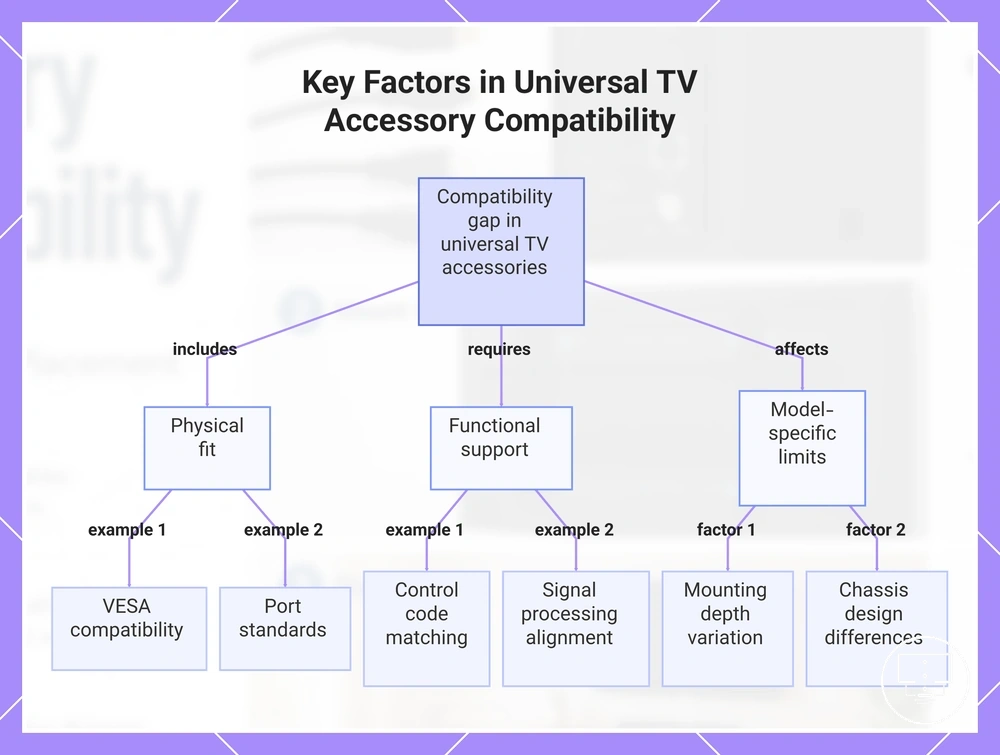
Universal TV accessories depend on shared standards such as VESA compatibility, port standards, and basic control behavior, but their actual usability is still shaped by brand-specific limits in real TV setups. Universal claims usually describe physical alignment rather than full functional support. This separation helps clarify when a compatibility claim is reliable and when it still requires verification.
Physical fit and functional support do not always align even when a universal TV accessory appears compatible. A mount or adapter may match VESA compatibility or port standards, but functional support can vary depending on how the TV processes signals and control inputs. This difference creates a gap between installation fit and real operating behavior.
Model-specific limits affect how universal TV accessories perform across different brands and devices. Control codes for remotes may not match, port standards may vary in implementation, and mounting depth or chassis design can change physical fit outcomes. These factors mean compatibility claim checks are still required even for universal accessory categories.
Decision-making depends on separating physical fit from functional support before trusting universal claims. VESA compatibility, port standards, control codes, and model-specific limits should be checked together to confirm real usability rather than assumed compatibility. This approach reduces mismatch risk in mixed-brand setups. :contentReference[oaicite:0]{index=0}
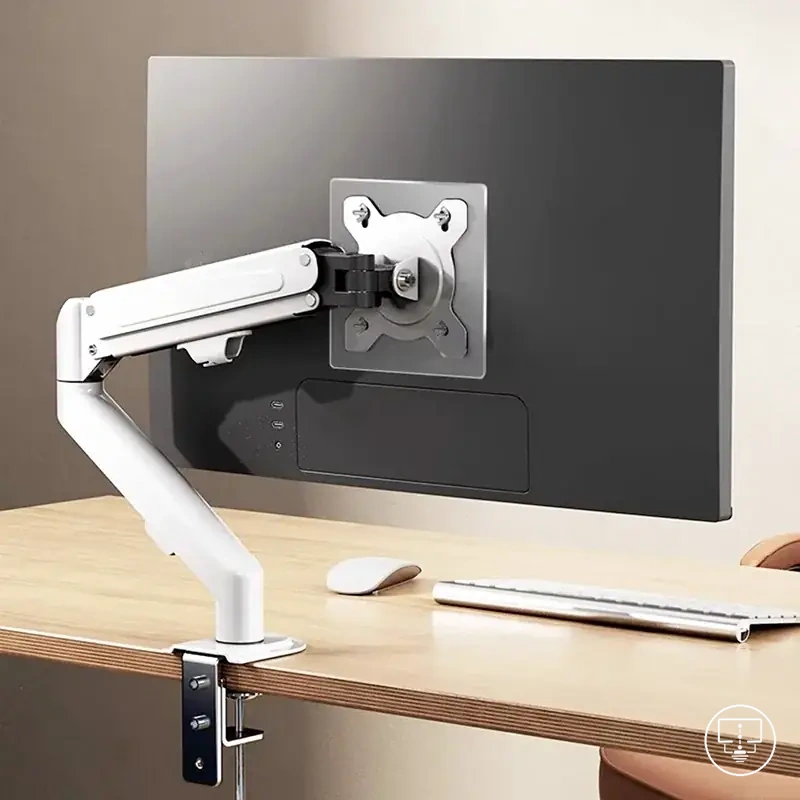
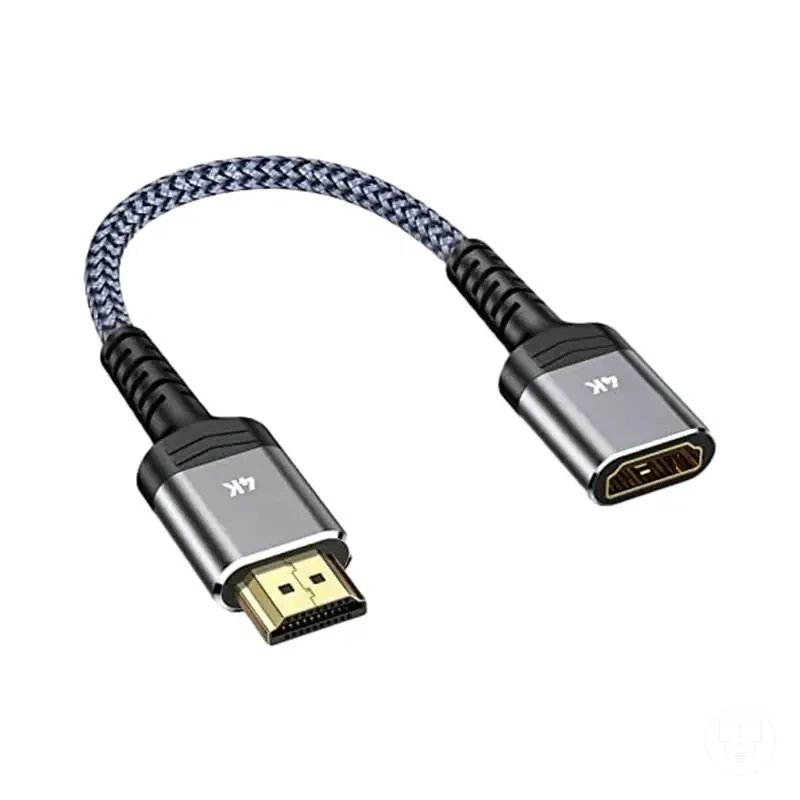
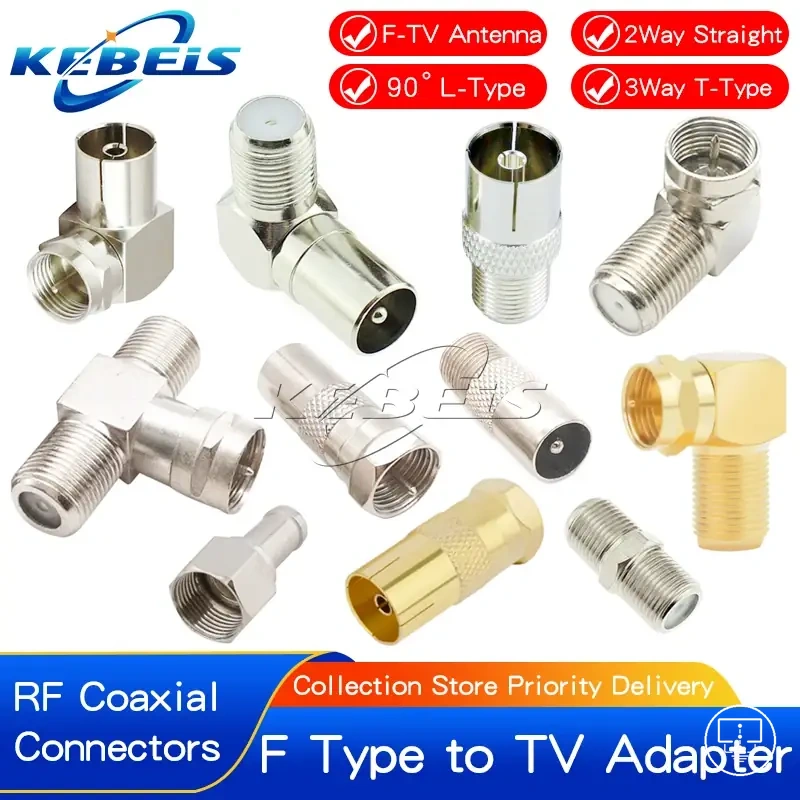
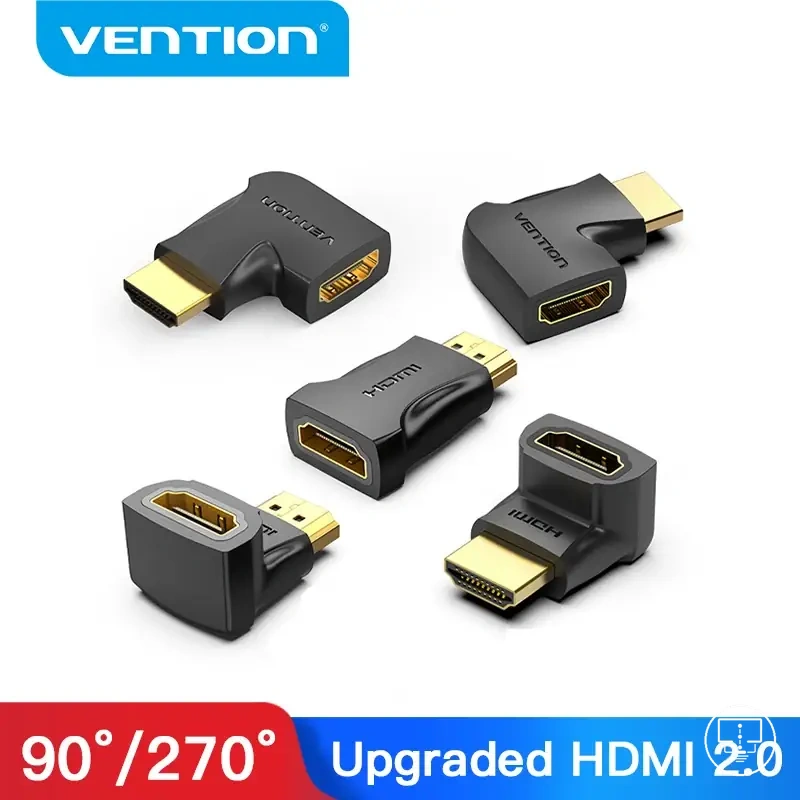
The products below are useful examples for comparing available options. Before buying, check that the compatibility criteria, key features, and product details match your needs.

This chart shows the main areas to verify when using universal TV accessories, separating physical fit from functional support and highlighting model-specific limits.
Compatibility checks before choosing accessories
Compatibility checks before choosing accessories ensure that the TV specification, accessory requirement, room constraint, and risk level are verified before any selection decision. These compatibility checks help reduce mismatch between model features and accessory limitations. All checks should be completed before selection to avoid avoidable fit or function issues.
The checklist below organizes the pre-purchase verification sequence into a structured set of compatibility checks. It covers TV specification, accessory requirement, room constraint, and risk level to support a clear decision path.
- Model number and manual verification
- Port type and port standard check
- VESA compatibility and mounting pattern alignment
- Weight limit and screw requirement confirmation
- Clearance and available space measurement
- Cable path and routing feasibility
- Smart feature support (when required)
- Intended use case validation
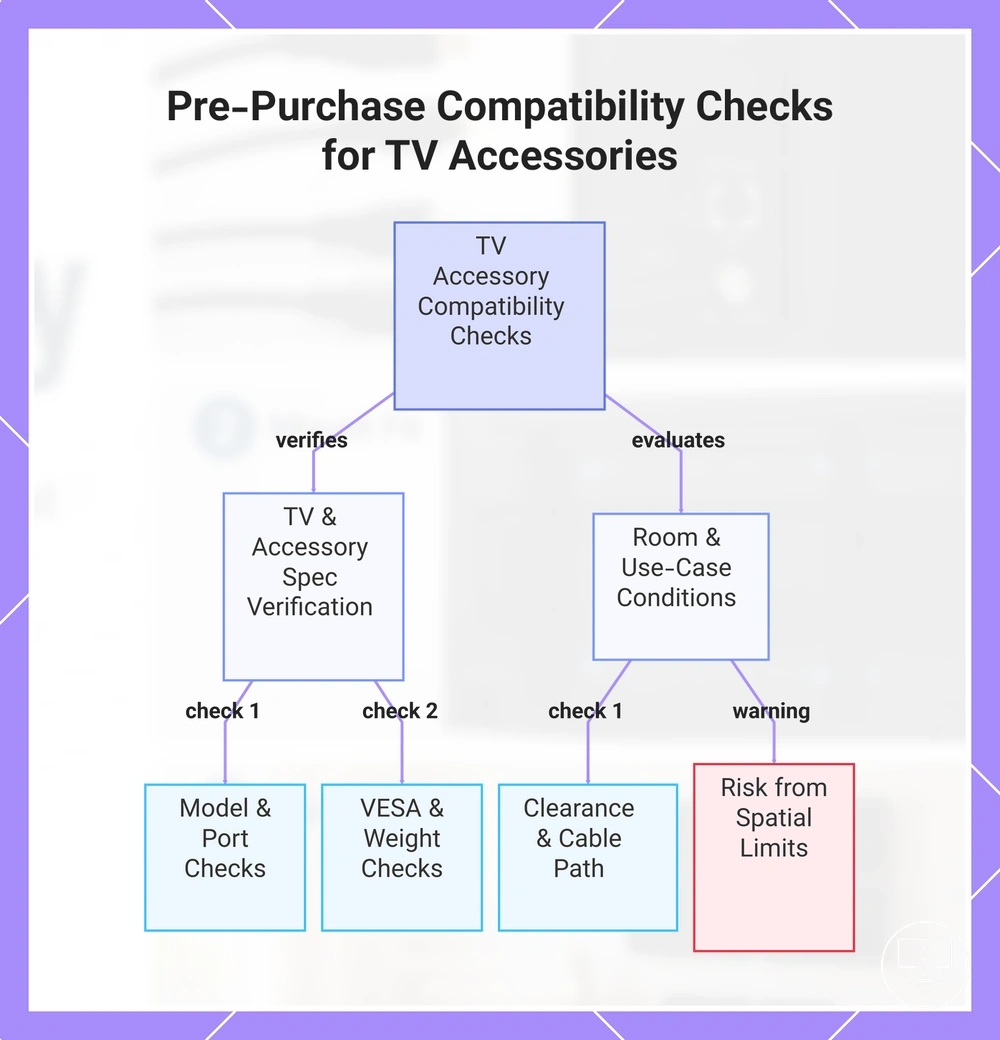
TV specification and accessory requirement checks focus on confirming the model number, manual details, port, and VESA compatibility before moving forward. These checks ensure the accessory requirement matches the device capability, including weight and screw fit conditions. The accessory checklist provides a structured way to follow these verification steps in order.
Room constraint and use-case conditions define whether a compatible accessory will work in real environments. Clearance behind the TV, cable path routing, and available installation space can affect usability even when technical compatibility is confirmed. Risk level increases when spatial limitations are not properly measured.
After completing all compatibility checks, the decision process moves toward selecting suitable accessories based on verified conditions. This reduces uncertainty and supports a more accurate decision outcome. The next step is to choose compatible accessories using confirmed TV specification and environmental constraints.
The products below are useful examples for comparing available options. Before buying, check that the compatibility criteria, key features, and product details match your needs.
This chart shows the two main categories of compatibility checks for TV accessories: TV specification verification and room condition evaluation, including a warning about spatial limitations.
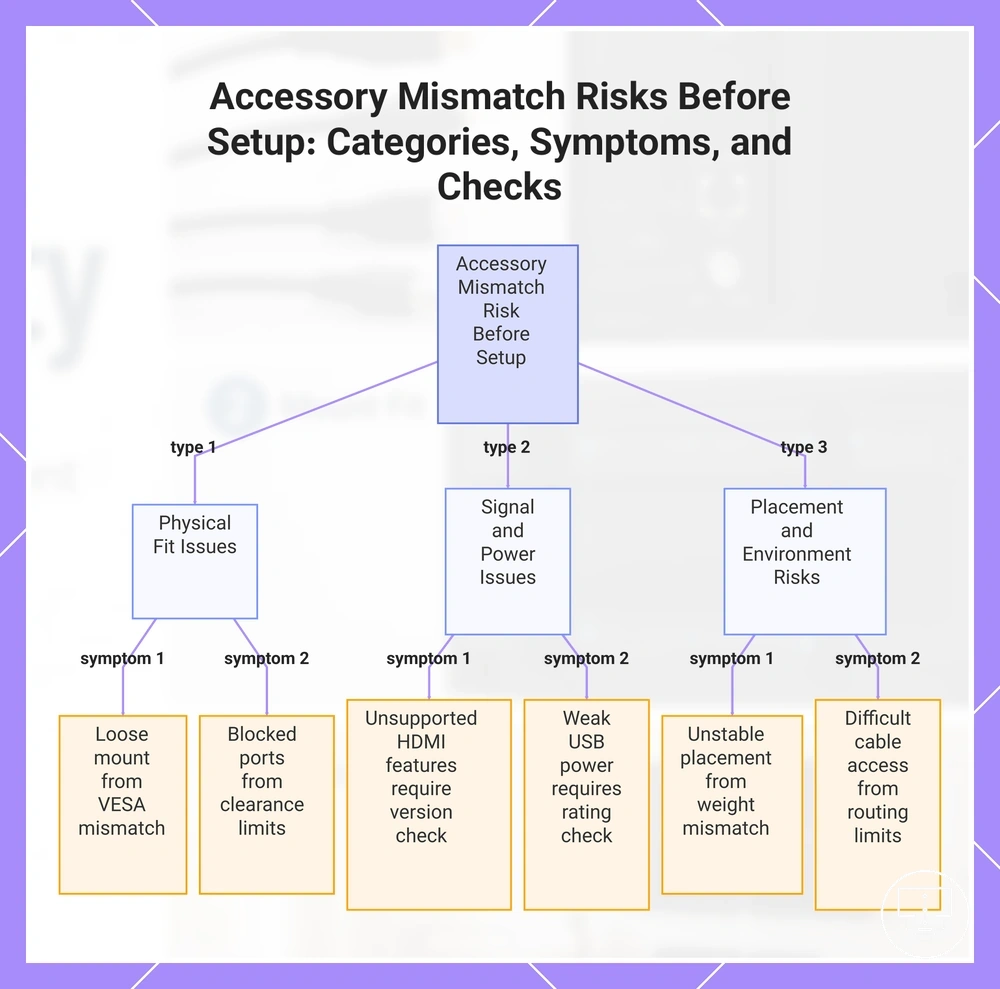
Accessory mismatch risks before setup
Accessory mismatch risk happens when an accessory physically fits the TV setup but does not meet required conditions for signal, mounting, or room environment. This creates a setup risk where connection or installation appears correct but functional behavior fails. In most cases, accessory mismatch risk should trigger rechecking specifications, not assumptions about compatibility.
The diagnostic list below organizes accessory mismatch risks before setup by linking each symptom to a likely cause and the required check. This helps identify where compatibility problems may occur across physical fit, signal behavior, and placement conditions.
- Loose mount or unstable fit: Likely caused by VESA or screw mismatch; check VESA pattern and screw size
- Blocked ports: Likely caused by rear layout or clearance limits; check port access and available clearance
- Unsupported HDMI features (no signal or limited output): Likely caused by signal mismatch; check HDMI version and device support
- Weak USB power: Likely caused by insufficient power output; check USB power rating and device demand
- Unstable placement: Likely caused by weight or support mismatch; check load rating and surface stability
- Difficult cable access: Likely caused by routing or space limitation; check cable path and rear clearance
Common accessory mismatch patterns appear when physical fit is correct but functional or environmental conditions are not aligned. For example, blocked ports may occur due to limited clearance even with the correct accessory, while unsupported HDMI features may limit expected performance even when connection works. Weak USB power can interrupt accessory behavior even when ports match physically.
When accessory mismatch risk appears, it should be treated as a signal to recheck specifications before replacing multiple accessories. In many setups, resolving the cause requires verifying model-level requirements and installation conditions rather than assuming a single faulty component.
This chart groups accessory mismatch risks into three categories—physical fit, signal/power, and placement/environment—and shows each symptom's likely cause and the required check before setup.