

Gaming TV setup accessories and compatibility guide
Gaming TV setup accessories are support items that help a TV, console or gaming device, cables, power source, placement area, and control setup work together for a playable TV gaming environment. The right accessory choice depends on the TV inputs, the console or PC output, the cable rating, the room layout, the power access, and the number of connected devices, so compatibility should be checked before treating any cable, mount, lighting kit, controller holder, or adapter as suitable.
A gaming setup usually needs a reliable connection path first, then placement, cable control, controller access, and optional comfort or immersion accessories. HDMI and connection accessories may matter when the TV and source device support higher display features, while mounts, stands, cable organisers, power accessories, and storage items often depend more on physical fit, clearance, ventilation, and how often devices need to be moved or changed.
The useful distinction is that gaming TV setup accessories do not create unsupported TV or console features by themselves; they help preserve or organise the setup conditions that the devices already support. A suitable accessory plan therefore starts with the devices and room conditions, then adds only the accessory categories that solve a real connection, access, comfort, organisation, or setup-control need.
Gaming TV setup accessories and the roles they support
Gaming TV setup accessories are support categories that help manage connection, placement, control access, audio, cable routing, or viewing conditions around a gaming TV setup. Their role is defined by the need they address, which means different setups may prioritize different accessories depending on the TV, console, room layout, or cable path.
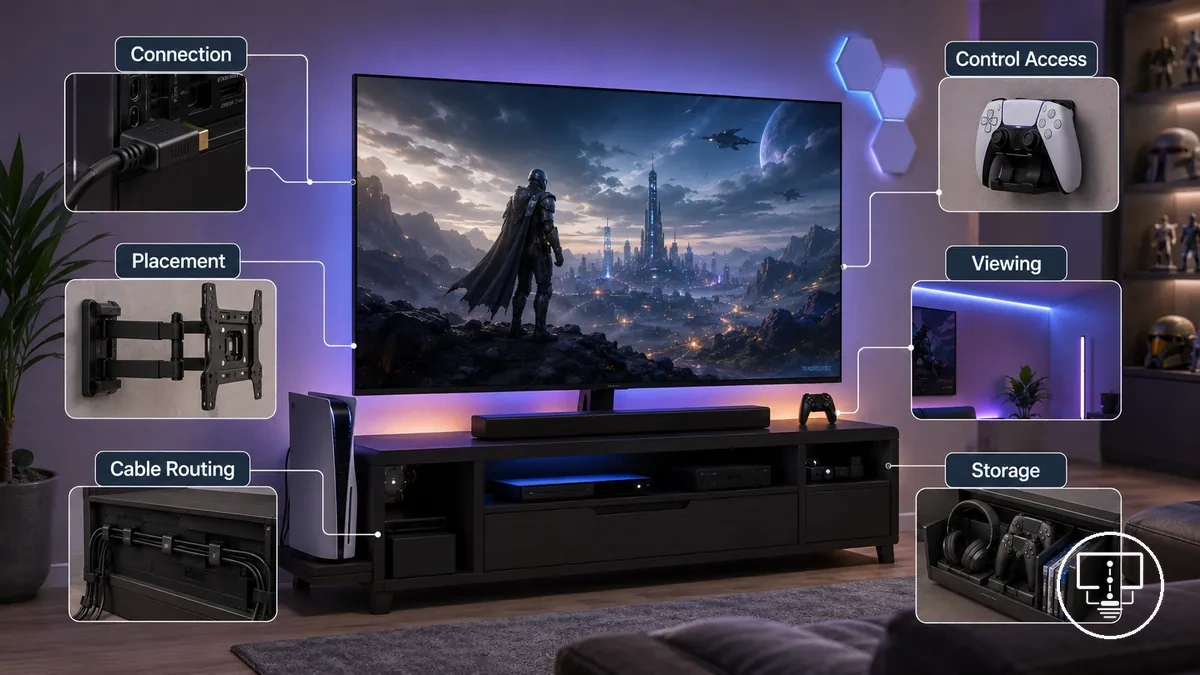
Role-based selection is often more useful than viewing accessories as a simple product list. HDMI cables support device connections, mounts and stands support screen positioning, controller holders support organization, and lighting accessories may support viewing conditions when the room layout allows. As a broader category boundary, TV setup accessories can serve many entertainment environments, while gaming-focused accessories are usually chosen around gaming devices, connection paths, and usage patterns.
Accessory roles can overlap. A mounting solution may support placement and cable routing at the same time, while a charging or storage accessory may support both access and organization. The practical value of each role depends on how the TV, gaming devices, furniture layout, and connected equipment are arranged within the setup.
HDMI and connection accessories for gaming TVs
HDMI and connection accessories for gaming TVs depend on a complete signal path that links a source device, a connection method, and a compatible TV input. Connection quality is influenced by how the console or PC output, cable path, adapter choice, and TV port work together, so the connection chain should be evaluated as a system rather than as a single cable or accessory.
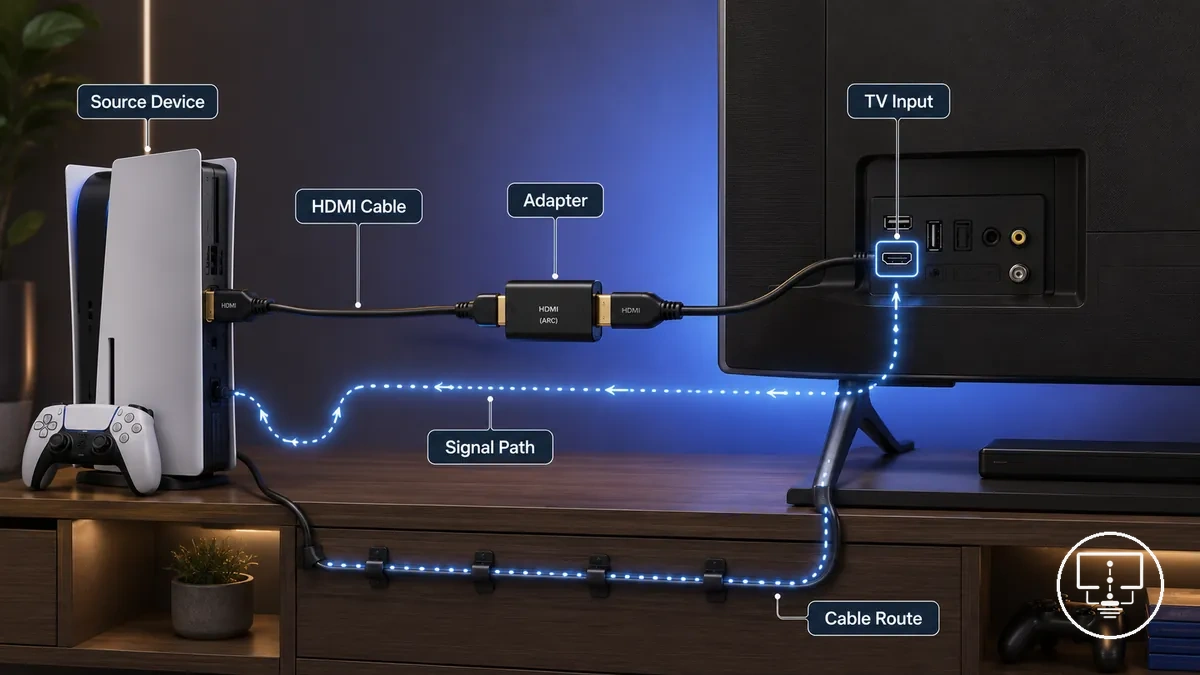
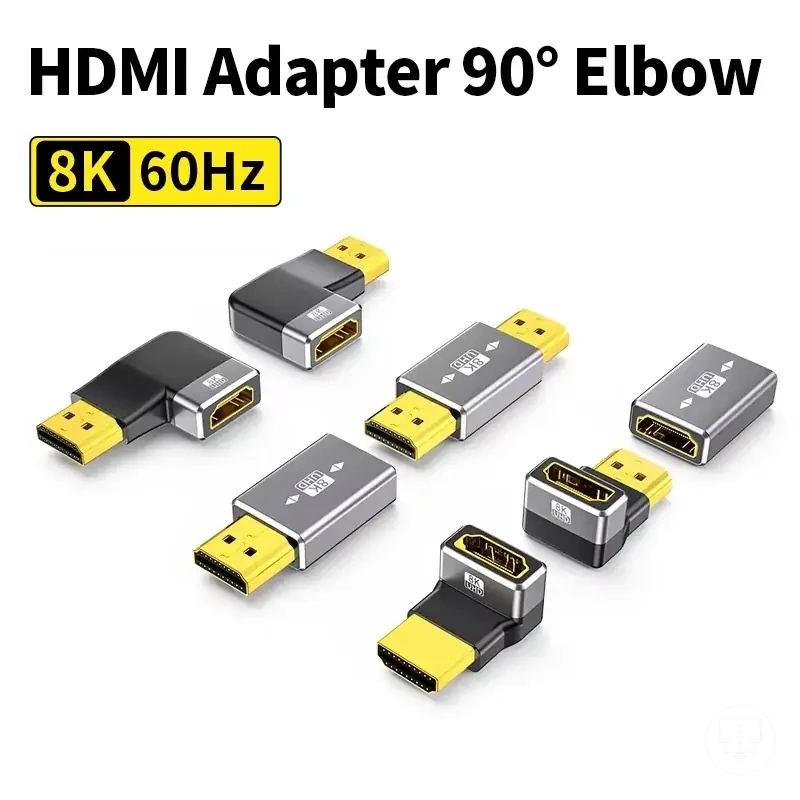
HDMI cables, adapters, couplers, switch devices, and extension accessories serve different connection roles. A cable carries the signal between devices, while an adapter may help connect devices with different port types. Signal behavior can vary when adapters, extensions, or multiple connection points are added to the path, especially when the TV, source device, or connection accessory supports features that rely on the full signal chain remaining compatible.
Connection accessories are most useful when their purpose matches the setup conditions. Port availability, cable routing distance, device placement, and source-device output can influence which accessory category is appropriate. For broader information about related gaming connection accessories, it is useful to compare the role of each connection component rather than assume that every cable or adapter supports the same usage requirements.
HDMI 2.1, bandwidth, and high refresh rate support
HDMI 2.1, bandwidth, and high refresh rate support depend on the cable rating, the TV input, the source output, and the selected display mode working together. A cable may support a higher-capacity signal path, but the TV and source device still need compatible ports and settings before features such as 4K, 120 Hz, VRR, or HDR can be available.
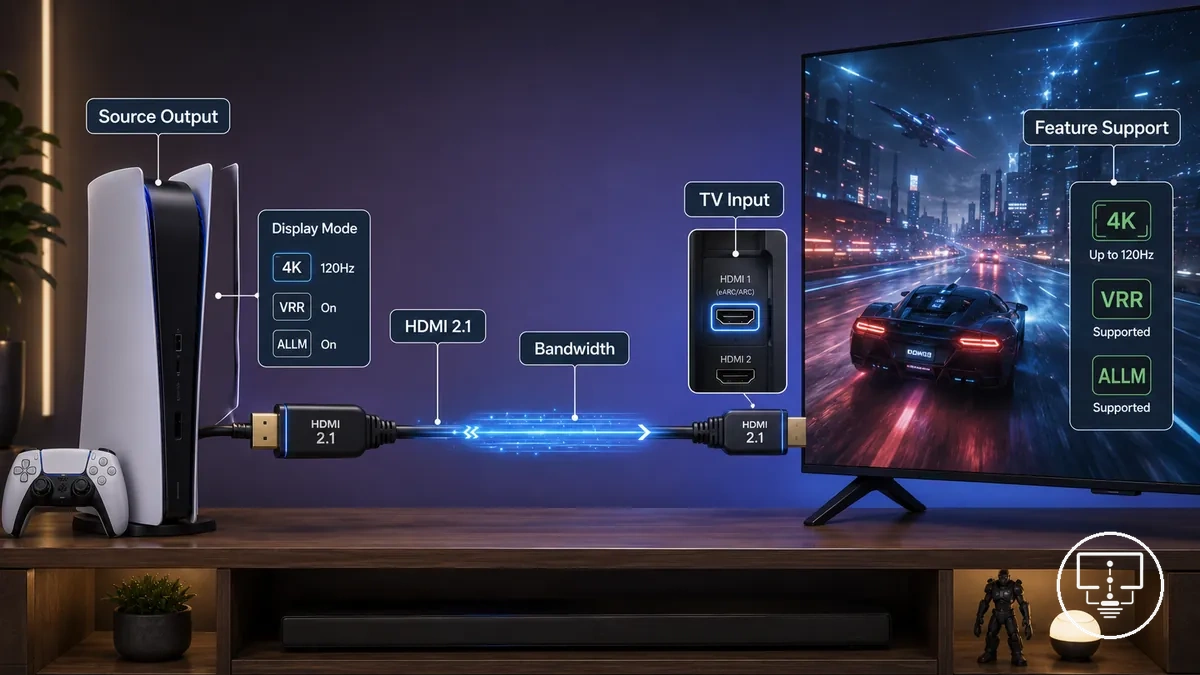
The important distinction is cable capability versus device capability. HDMI bandwidth can help carry more demanding video signals when the full connection chain supports them, but a cable cannot add refresh rate, HDR, or VRR support to a TV input or source output that does not provide those features. Display mode settings may also influence whether supported features are active.
HDMI 2.1 should be treated as one condition in the support chain rather than a standalone guarantee. The safer approach is to align the cable, TV port, source output, and display settings before assuming that a higher refresh rate or advanced display feature will be available in a specific gaming TV setup.
Cable length, port access, and adapter limits
Cable length, port access, and adapter limits depend on the physical connection route between the source device and the TV. Longer cable routes need adequate reach, while connector clearance, port location, and cable bend direction can affect access and may increase strain on the cable or port when space is limited.
Port access becomes more important when a TV is placed inside furniture, close to a wall, or mounted with limited rear clearance. A physically compatible cable may still be difficult to connect if the connector housing, cable thickness, or installation angle restricts access. In these situations, connector orientation and available space can influence whether the connection remains practical.
Adapters can help when device ports or connector layouts do not align directly, but their usefulness depends on the connection path and installation conditions. Additional connection points may influence how an otherwise compatible setup behaves, and the outcome can vary with the cable, adapter type, device ports, and cable route. Physical setup constraints can therefore affect connection reliability even when the TV and source device are otherwise compatible.
TV and console compatibility checks before choosing accessories
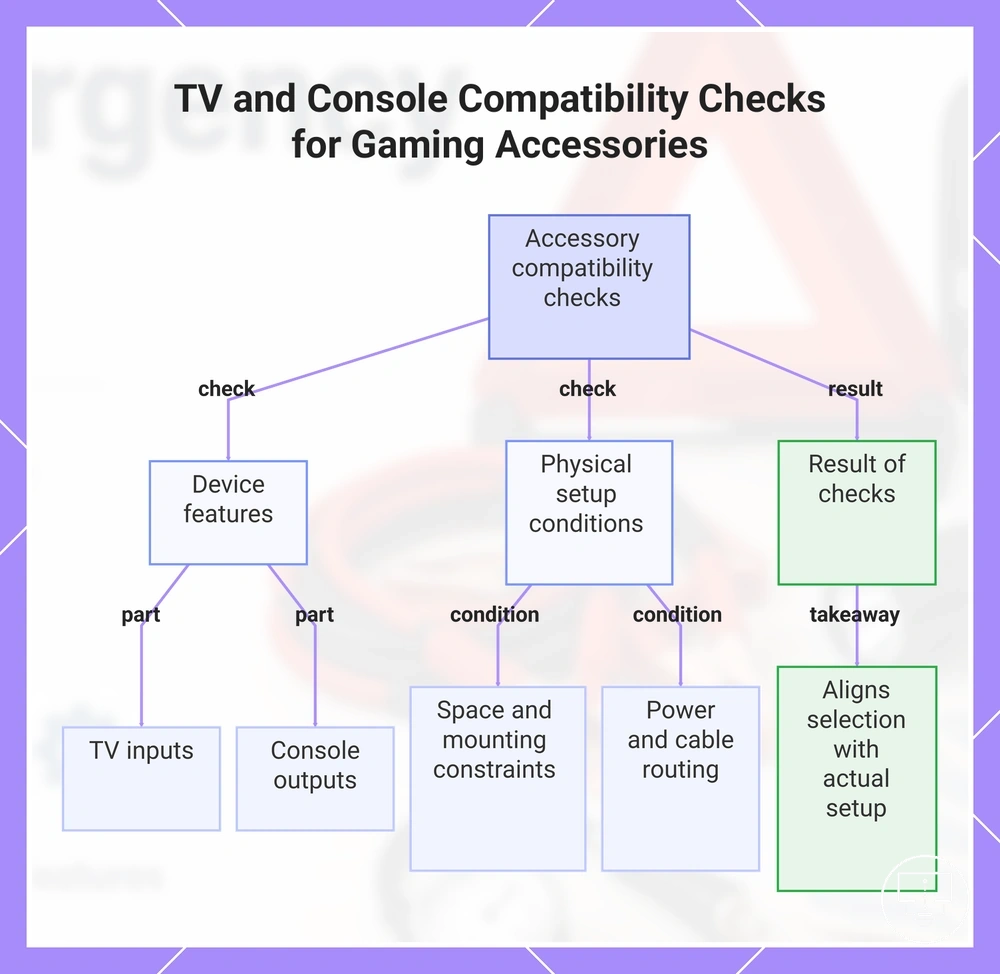
TV and console compatibility checks before choosing accessories depend on both device features and physical setup conditions. Accessory suitability is influenced by TV inputs, console outputs, available space, mounting arrangements, power access, and cable routing paths, so these conditions should be checked before selecting accessories for a gaming setup.
Compatibility should be verified by comparing accessory requirements with the actual TV, console, and room conditions. Display-feature support may depend on the connected devices, while mounting accessories depend on fit and placement constraints. For broader gaming accessory compatibility considerations, it is useful to evaluate connection access, mounting clearance, power availability, and device layout before selecting an accessory category.
Gaming accessory selection is often influenced by practical setup constraints rather than device support alone. A TV and console may support the intended gaming functions, yet cable routes, furniture placement, wall-mount positions, controller storage locations, or power-access limitations can still affect whether an accessory remains suitable for the environment. Checking these conditions first helps align accessory selection with the actual gaming setup.
This chart shows the main device features and physical setup conditions to check when selecting gaming accessories, along with the benefit of performing these checks.
TV ports, game mode, VRR, HDR, and display feature support
TV ports, game mode, VRR, HDR, and display feature support depend on the TV, source device, and connection path working together. A compatible accessory should match the available TV inputs and intended display features because feature availability may vary by port, input configuration, selected settings, and connected device support.
TV input conditions can influence whether gaming features are available. Certain ports may support different feature combinations, while input labels or gaming-related settings can affect how the TV processes the incoming signal. Game mode, VRR, HDR, and refresh-rate options may require specific settings to be enabled before they can be used, and the outcome can vary by TV model and source configuration.
Cable rating and accessory selection should be evaluated alongside display-feature requirements rather than separately. An accessory may help complete a compatible connection path, but it cannot create VRR, HDR, refresh-rate support, or other display features that the TV or source device does not provide. Checking port availability, active settings, and intended feature use can therefore help determine whether an accessory remains suitable for a gaming TV setup.
Console and PC connection differences for TV gaming
Console and PC connection differences for TV gaming depend on the source device output path and the connection requirements needed to reach the TV. Accessory choice may change when the source device uses different output types, requires an adapter, or relies on specific display settings, so compatibility should be evaluated from the source device outward rather than from the cable alone.
Console connections often follow a more direct connection path, while PC connections may vary depending on available outputs, display configurations, and port access. A PC may require additional connection accessories when the output type does not match the TV input, whereas a console connection may depend more on cable routing, port availability, and display-feature configuration. The accessory requirement therefore depends on the connection condition rather than the gaming platform itself.
Source-device differences can also influence display setup and accessory suitability. Display modes, refresh-rate settings, and connection layouts may vary between consoles and PCs, which can affect whether an adapter, cable, switch device, or routing accessory is appropriate. Evaluating the source output, available TV inputs, and physical connection path helps align accessory selection with the actual TV gaming setup.
Mounting and placement accessories for gaming comfort
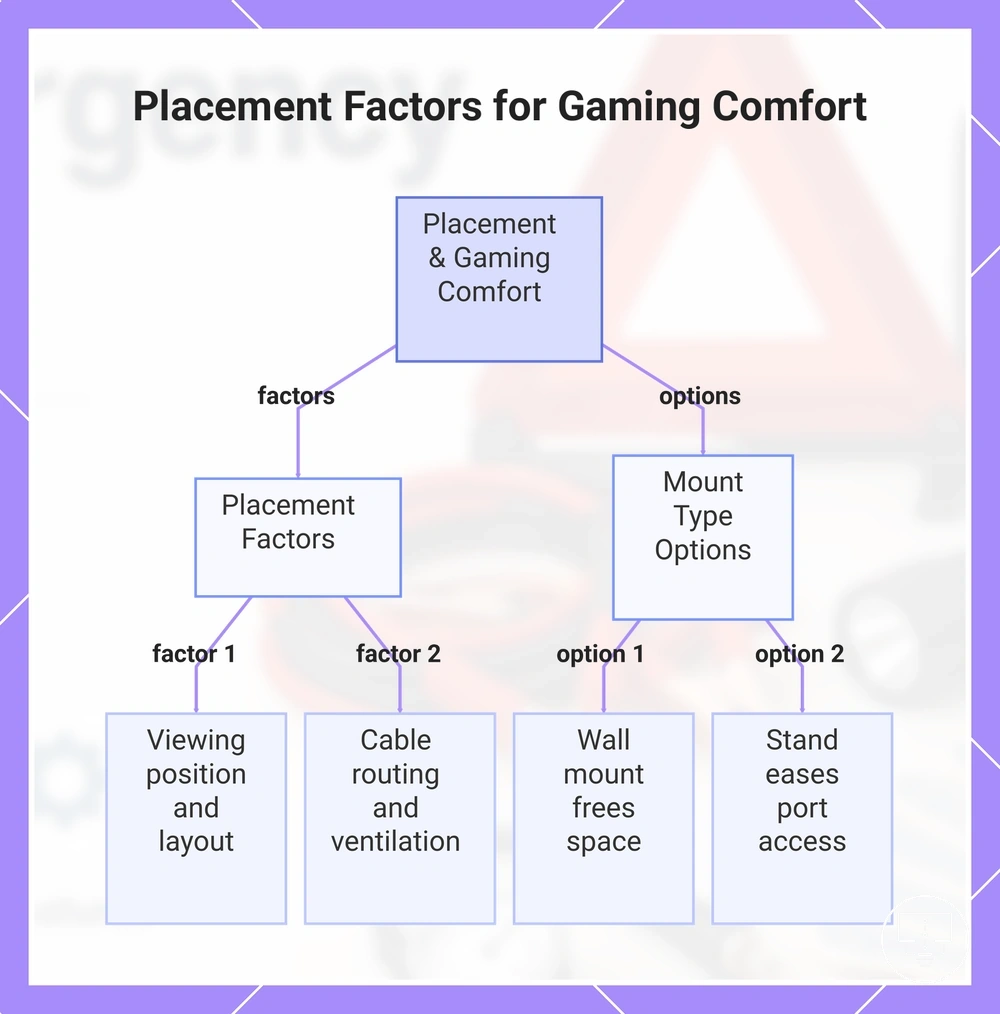
Mounting and placement accessories for gaming comfort start with the placement condition because screen position directly affects access, ventilation, and cable routing. A mount or stand may improve comfort when it suits the room layout, viewing position, and equipment arrangement, while unsuitable placement can make cable access, controller use, or device reach less practical.
Placement affects gaming usability by influencing how easily connected devices can be accessed and how cables are routed between the TV and gaming equipment. A wall mount may help free surrounding space when the room layout supports it, while a stand may provide easier access to ports and connected devices in setups where equipment is changed frequently. The comfort outcome depends on viewing position, available space, and how the gaming devices are arranged around the TV.
Ventilation and cable reach should be considered alongside placement decisions. A mount or stand that fits the available space may help maintain access around connected devices, but the result can vary with furniture placement, cable length, device location, and room configuration. Placement therefore influences not only viewing comfort but also the practical usability of the gaming setup through access, airflow, and cable management conditions.
This chart shows the key placement factors and mount options that influence gaming comfort and setup usability.
TV mounts and console wall mounts for gaming setups
TV mounts and console wall mounts for gaming setups should be evaluated by fit, support, access, and placement conditions before considering the mounting location. A TV mount depends on the TV mounting pattern and support requirements, while a console wall mount depends on console dimensions, available clearance, cable access, and surrounding space. The suitability of either mount can vary with the TV, console, wall surface, and room layout.
A TV mount affects screen placement and viewing access, while a console wall mount affects device access and cable organization. The mount type should allow reasonable access to ports, power connections, and cable routes after installation. If access becomes restricted by wall position, furniture placement, or cable direction, routine connection changes may become less convenient.
Console wall mounts can help free shelf or cabinet space when the setup layout supports wall placement, but they may also introduce limits if cable clearance, ventilation space, or port access becomes restricted. Checking fit, support conditions, access points, and surrounding clearance helps determine whether a TV mount or console wall mount remains suitable for a gaming setup without assuming universal compatibility.
Viewing position, ventilation, and cable reach
Viewing position, ventilation, and cable reach depend on how the TV and gaming devices are physically arranged within the setup. A suitable placement condition balances screen visibility, airflow around equipment, and practical cable access, while the ideal arrangement can vary with room size, seating position, outlet location, and furniture layout.
TV position influences viewing conditions and gaming usability. A screen that is positioned appropriately for the room and seating arrangement may provide a more comfortable viewing experience, while a placement that requires frequent repositioning or awkward viewing angles can reduce usability. The effect depends on the available space and how the gaming area is used.
Device placement affects both ventilation and cable reach. Restricted airflow around a console, media device, or accessory can increase heat-related concerns, while limited cable reach may make device access or connection changes less convenient. Allowing reasonable airflow, outlet access, and cable slack where the setup permits can help maintain usability without relying on fixed placement rules.
Cable management for consoles and gaming devices
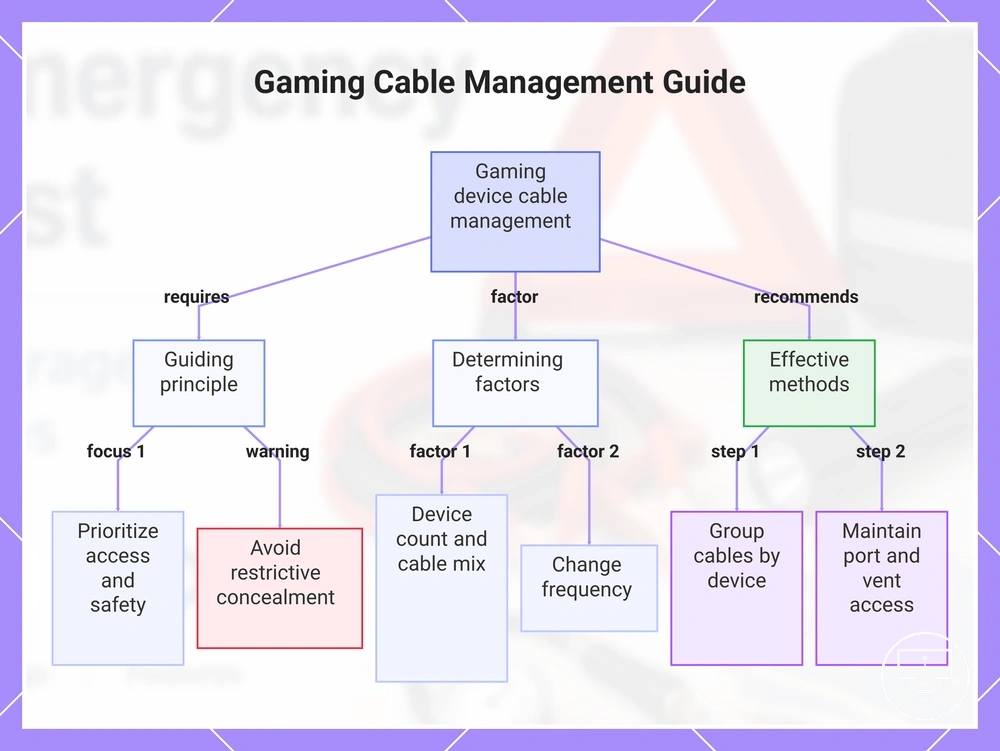
Cable management for consoles and gaming devices starts with maintaining access, safety, and future flexibility rather than simply hiding cables. The most suitable organization method depends on the number of gaming devices, the mix of power, charging, Ethernet, and display cables, and how often equipment is connected, moved, or replaced.
Cable type influences how cables should be grouped and routed. Power cables, charging leads, network connections, and display cables may benefit from different routing paths when access and maintenance are priorities. A cable fastener, sleeve, clip, or organizer can help keep routes more manageable when it allows cables to remain identifiable and accessible for future device changes. If cable concealment restricts access, troubleshooting or adding equipment may become more difficult later.
Gaming device count can affect cable management needs. A single-console setup may require only basic organization, while a multi-console or multi-device arrangement can create additional charging leads, network connections, and power cables that compete for space. Organizing cables by device group and maintaining reasonable access to ports, outlets, and ventilation areas can improve usability and make future setup changes easier without relying on permanent or restrictive cable-routing methods.
This chart outlines the guiding principles, determining factors, and recommended practices for managing cables in a gaming setup while prioritizing access and avoiding restrictive concealment.
Hiding power and HDMI cables around the TV area
Hiding power and HDMI cables around the TV area should preserve access and safety before improving appearance. A suitable routing method depends on the cable type, the path between devices, and whether future access is needed for equipment changes, troubleshooting, or maintenance.
Power cables and HDMI cables often have different routing considerations. Cable sleeves, clips, raceways, or cabinet exit points may help reduce visible cable clutter when they allow cables to remain accessible and avoid unnecessary strain. If a routing method restricts access to power connections or makes cable replacement difficult, future setup changes may become less convenient.
Cable hiding is not always the same as cable management. Concealing cables can reduce visibility, while cable management focuses on maintaining access, organization, and usability. HDMI cables may benefit from routing that avoids excessive tension near connection points, while power cables should remain accessible and routed in a way that supports safe use. The most practical approach depends on the TV area, device layout, and how often cables or gaming equipment may need to be changed.
Managing multiple consoles without blocking access
Managing multiple consoles without blocking access starts with keeping each device reachable for connections, charging, and future changes. As device count increases, the number of cables, power connections, and access points also increases, so organization should prioritize usability before concealment.
Multiple consoles can change how HDMI inputs, power outlets, and cable routes are used. Labels, grouped cable paths, and controlled cable slack may help identify connections more easily when devices are swapped or moved. If available TV inputs become limited, a switching solution may be useful, but the need depends on the number of connected devices and the available connection options.
Access planning also affects charging and airflow management. Dedicated charging areas may help reduce cable congestion when multiple controllers or accessories are used, while maintaining reasonable space around consoles can support access and ventilation. The most suitable organization method depends on device count, connection frequency, and whether additional gaming devices may be added later.
Controller storage and gaming accessory organization
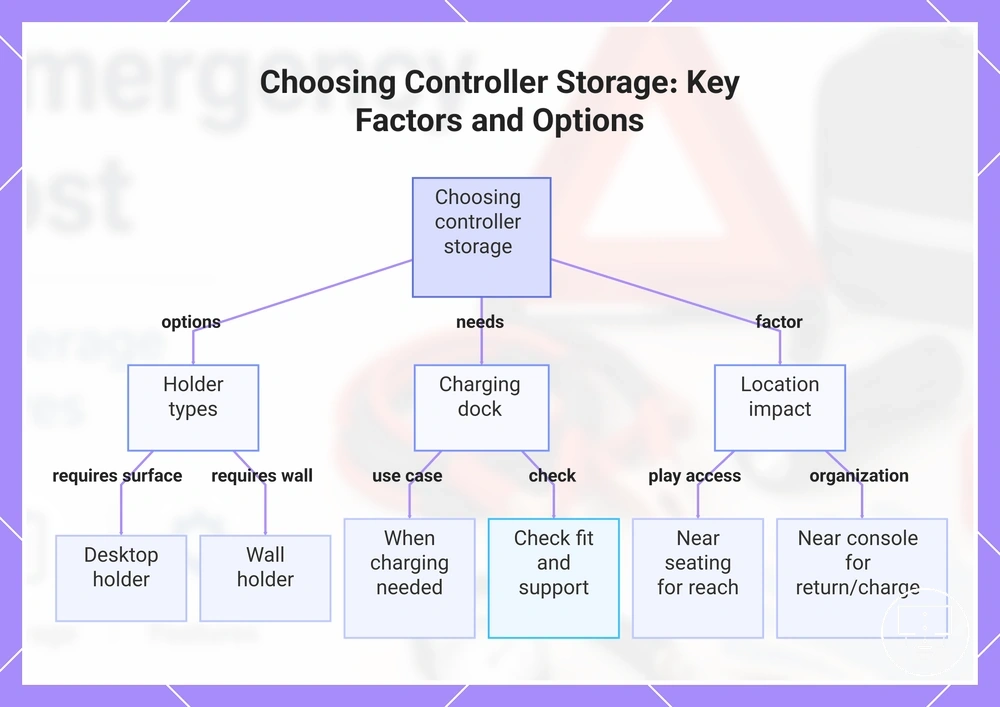
Controller storage and gaming accessory organization should support access, charging, protection, and clutter control around the gaming TV setup. The most suitable storage option depends on how the room is used, how many controllers or accessories need a place, whether charging is required, and how easily the items should be reached during play.
Storage type affects both placement and usability. A desktop holder may keep controllers close to the console area when surface space is available, while a wall holder may help reduce surface clutter when wall space and reach are suitable. A charging dock may be useful when controllers need a consistent charging location, but fit and charging support depend on the controller type and the dock design.
Storage location can change the recommendation more than the holder style itself. Accessories kept near the seating area may be easier to reach during play, while accessories stored near the console may be easier to return, charge, or keep grouped with related devices. Controller storage should therefore match controller count, charging needs, room layout, and everyday access patterns rather than assuming one organizer suits every gaming setup.
This chart shows the main factors to consider when selecting a controller storage solution, including holder types, charging dock use, and location impact.
Wall holders, stands, cabinets, and charging access
Wall holders, stands, cabinets, and charging access should be selected based on the balance between visibility, reach, available space, and charging convenience. The most suitable option depends on controller type, room use, available wall space, and whether controllers need regular access to a charging location.
Wall holders can keep controllers off nearby surfaces when wall placement is practical and permitted, while stands keep controllers visible and easier to reach in open gaming areas. Cabinets hide stored items from view and can reduce visible clutter, but controller access may be less immediate when controllers are used frequently. Each storage format changes the trade-off between visibility, access, and space use.
Charging access may also influence the storage decision. A holder or stand positioned near a charging point can make routine charging more convenient, while cabinet storage may require additional consideration for charging-cable reach and access. Storage suitability depends on placement conditions, controller type, and charging needs rather than assuming a single storage format works for every gaming setup.
LED backlights and ambient lighting for TV gaming
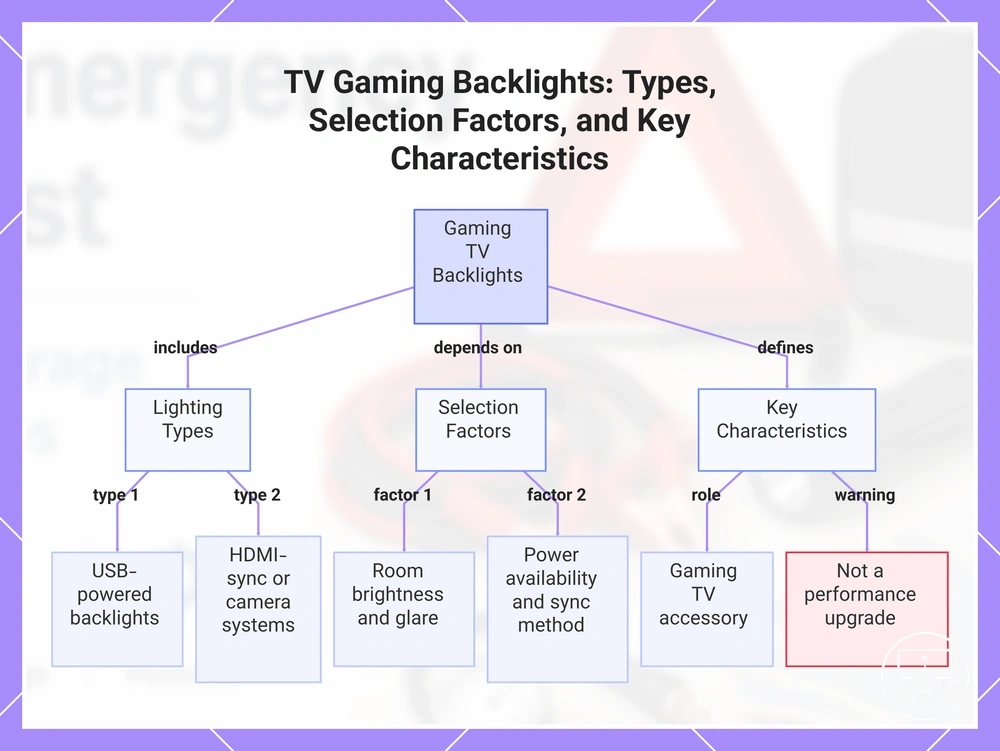
LED backlights and ambient lighting for TV gaming are typically used to support viewing comfort and visual immersion after core setup needs such as display placement, connectivity, and device organization have been addressed. The most suitable lighting approach depends on room brightness, glare conditions, power availability, and whether the lighting is intended to remain static or respond to on-screen content.
Lighting type affects both setup requirements and the viewing experience. USB-powered backlights may offer a simpler installation approach when a nearby power source is available, while HDMI-sync or camera-based systems may adjust lighting in response to screen activity. These systems can create different immersion effects, but the outcome may vary with room conditions, sync method, and setup compatibility.
Ambient lighting functions as a gaming TV accessory rather than a gaming performance upgrade. Backlights may help reduce the visual contrast between a bright screen and a darker room in certain conditions, while sync-based lighting may emphasize screen activity through changing light effects. The most appropriate option depends on the desired balance between comfort, immersion, setup complexity, and the gaming environment.
This chart shows the main types of gaming TV backlights, the factors that influence the choice, and the key characteristics that define their role.
USB, HDMI sync, and camera-based lighting limits
USB, HDMI sync, and camera-based lighting limits depend on how the lighting method receives power, accesses screen information, and interacts with the TV setup. USB-powered lighting typically relies on a power connection rather than a video signal, HDMI-sync systems depend on the signal path, and camera-based systems use screen-reading methods that may be influenced by TV placement and viewing conditions.
HDMI-sync lighting depends on compatibility within the video chain. Lighting behavior may vary when display formats, refresh settings, or HDR-related features pass through connected devices, and the outcome can depend on how the lighting system interacts with the overall setup. USB-powered lighting avoids most signal-chain constraints but usually does not respond directly to screen content.
Camera-based lighting uses screen observation instead of direct signal access, which may make it suitable when content comes from different devices or built-in TV applications. However, lighting response can vary with camera positioning, screen visibility, room conditions, and TV placement. These differences create distinct compatibility limits for each lighting method rather than providing universal support across every gaming TV setup.
Gaming TV setup accessory checklist by setup type
Gaming TV setup accessory priorities depend on the setup type because different gaming environments create different requirements for connectivity, placement, cable organization, storage, and lighting. A console-focused setup may prioritize connection and charging accessories, while a multi-console setup may place greater importance on device organization, cable routing, and input access.
For a wall-mounted gaming TV setup, mounting hardware, cable-routing accessories, and placement-related accessories may become higher priorities when cable visibility, equipment access, or device positioning are important considerations. For a clean-cable setup, cable organizers, routing accessories, and controller storage solutions may be more relevant when reducing visible clutter is a primary goal. To choose gaming TV accessories effectively, it helps to identify the setup condition first and then match accessories to the specific requirement rather than treating every accessory category as equally important.
A console-focused setup may benefit from controller charging and storage accessories when controllers are used regularly, while a multi-console setup may place greater value on device organization, cable identification, and access management. Ambient lighting, mounting accessories, storage solutions, and cable-management tools can be useful additions when they address a specific setup need, but the priority of each accessory category depends on the gaming environment, available space, and intended use pattern.
Essential accessories for console-focused TV gaming
Essential accessories for console-focused TV gaming depend on maintaining a suitable connection path, power access, and device placement arrangement. A compatible connection accessory is typically the highest-priority category because a console requires an appropriate path to connect to the TV before other accessory choices become relevant.
Connection accessories become the primary recommendation when TV inputs, cable routing, or equipment placement create a connectivity requirement. If the console and TV are positioned farther apart, a longer connection path may be needed. If available inputs are limited, an input-management accessory may become a higher priority than storage or lighting accessories.
Power-access and cable-management accessories can become essential when the setup includes multiple connected devices or limited outlet access. Controller charging accessories, cable organizers, and routing accessories may help maintain accessibility when controllers, cables, and power connections are used frequently, but their importance depends on the setup condition rather than the console alone.
Controller storage, mounting accessories, and ambient lighting are often useful additions when placement, organization, or viewing preferences create a specific need. For users who want to compare TV setup accessories, separating connection requirements from convenience-focused additions can help identify which accessory categories are necessary and which remain optional for a console-focused gaming setup.
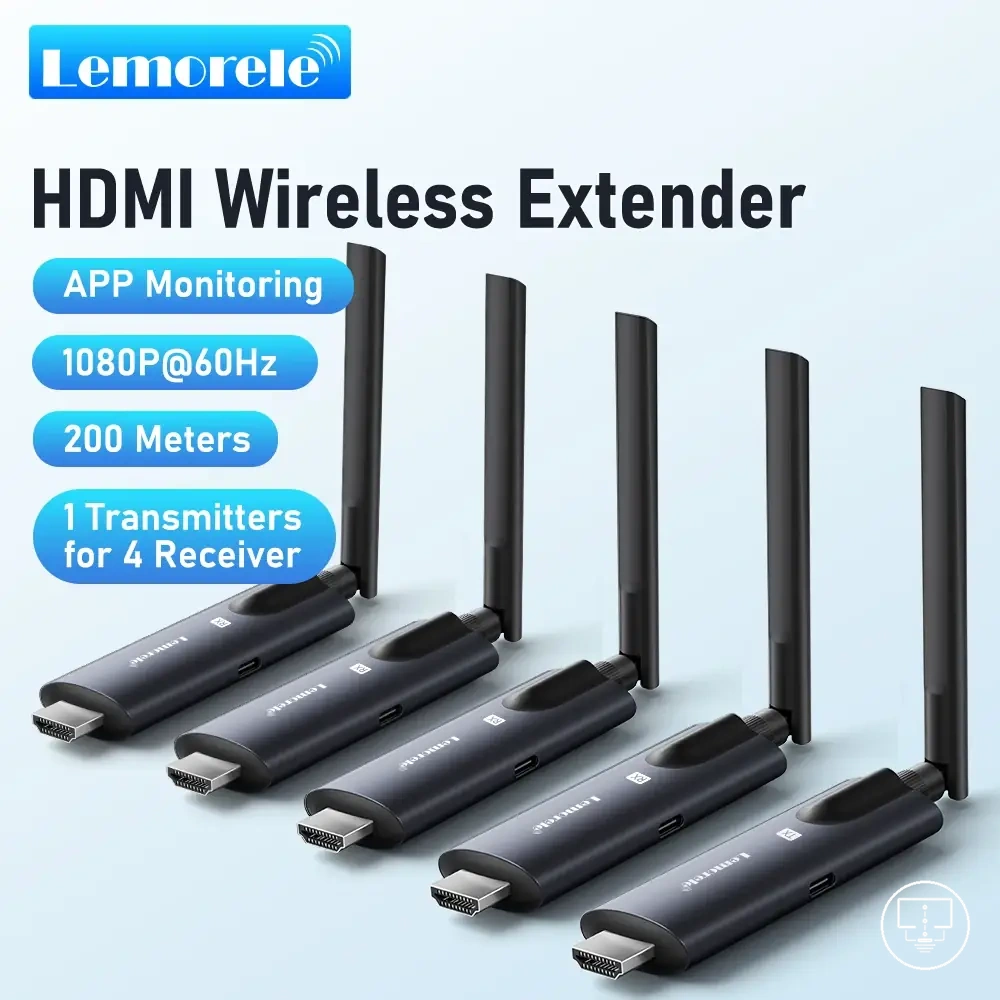
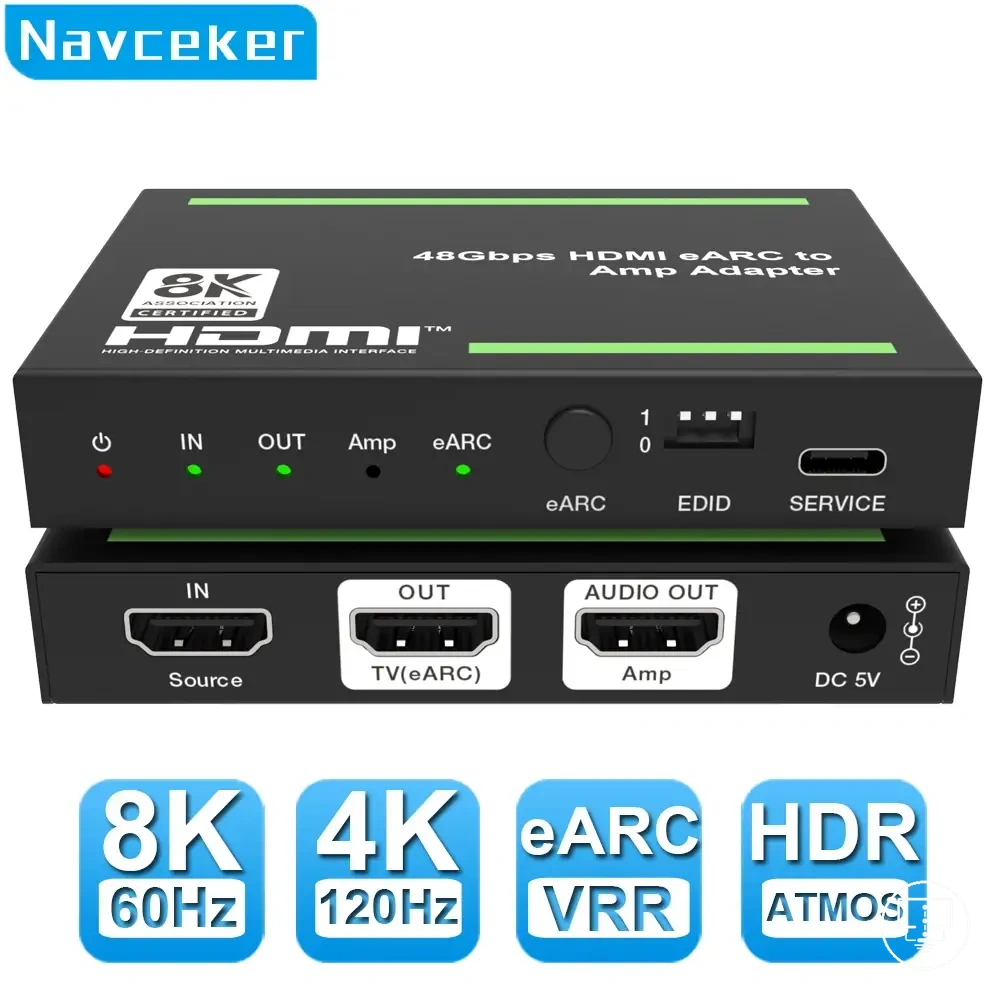
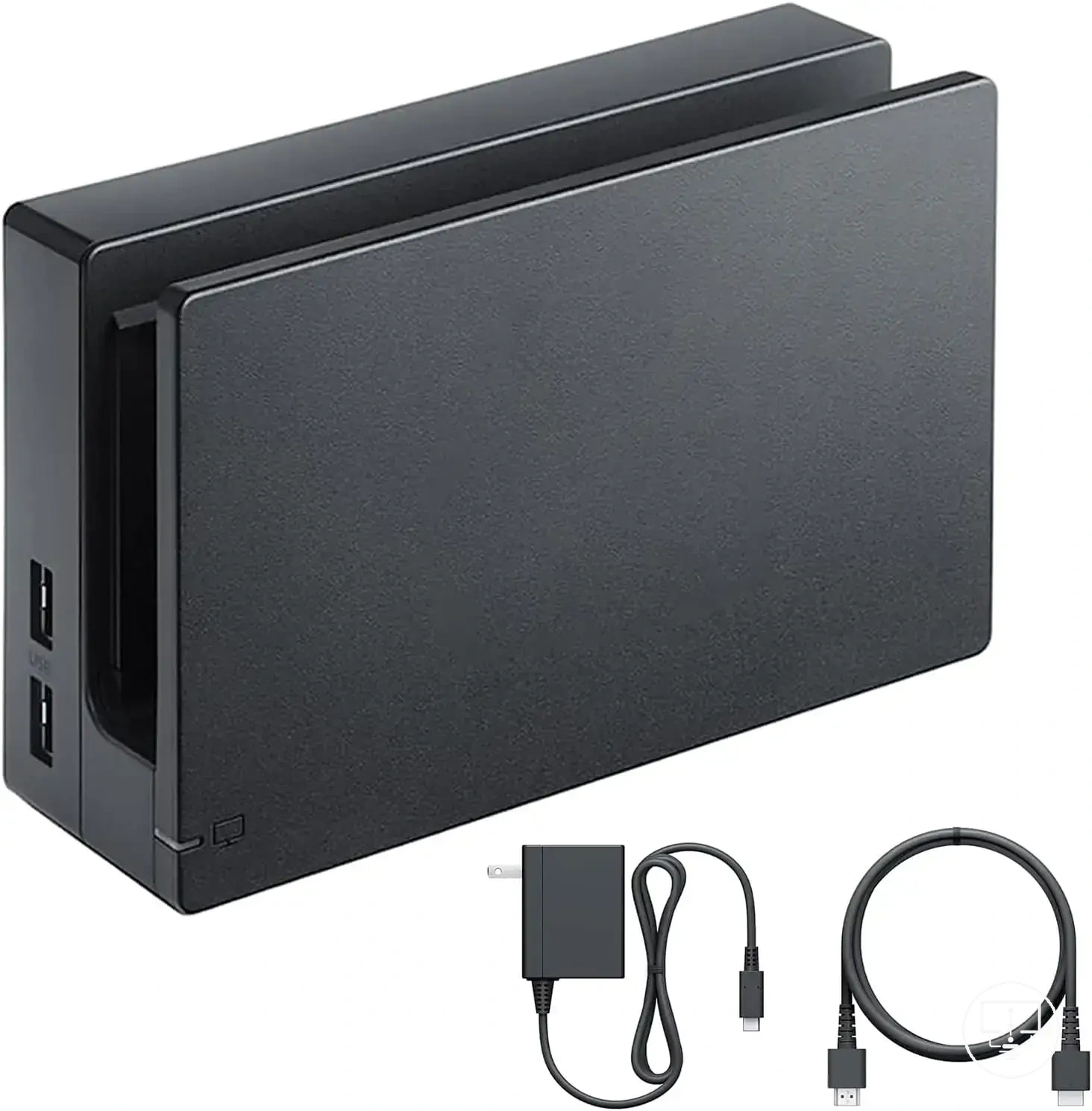
Here are product examples that may make comparison easier. Before buying, always review the compatibility criteria, essential features, and product details.
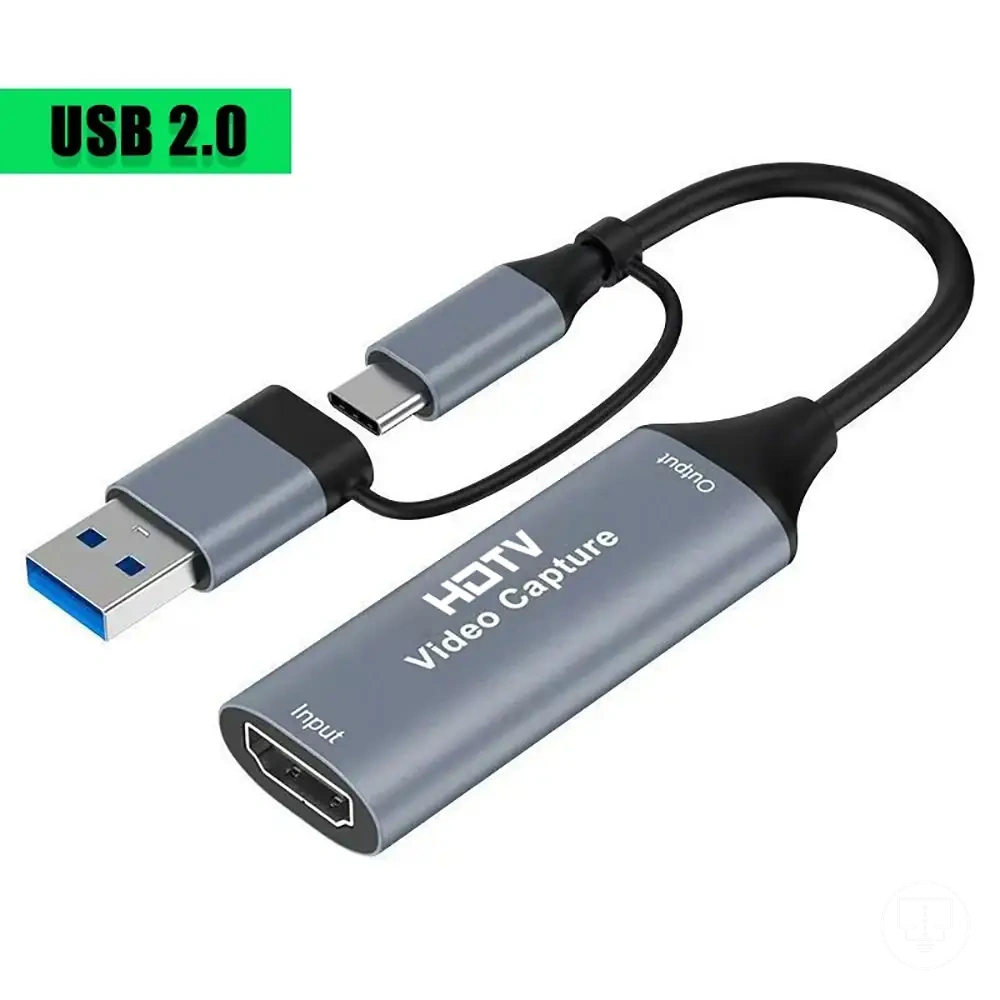
Optional upgrades for cleaner or more immersive setups
Optional upgrades for cleaner or more immersive setups are not required for every gaming TV arrangement because their value depends on room layout, device count, cable visibility, and viewing preferences. These upgrades are usually worth considering when the goal extends beyond basic functionality and focuses on organization, appearance, or a more customized gaming environment.
Cable-management accessories may provide greater value when multiple devices, controllers, or charging cables share the same area. Cable sleeves, routing accessories, and storage solutions can help create a cleaner setup when visible cable clutter is a concern, but they may offer limited benefit in simpler arrangements with fewer connected devices.
Ambient lighting and decorative setup accessories may be useful when visual atmosphere is an important part of the gaming experience. Their value often depends on room conditions, screen placement, and personal preference rather than on gaming requirements. A user focused primarily on gameplay functionality may find less benefit from these additions than a user prioritizing immersion or room presentation.
Mounting enhancements, accessory organizers, and advanced cable-routing solutions can improve convenience when placement constraints or space limitations exist. However, these upgrades are often unnecessary when the existing setup already provides adequate access, organization, and viewing comfort. The strongest value typically comes when an optional upgrade addresses a specific setup limitation rather than being added without a clear purpose.
Here are product examples that may make comparison easier. Before buying, always review the compatibility criteria, essential features, and product details.